
Welcome to all new subscribers! This is System Check, my roughly weekly rundown where I cover recent AI events and new research that relates to our work at Free Systems. It’s distinct from our main posts where we release our own new research.
We need a political economy of agent swarms
The METR report on the incident in which OpenAI agents colluded to break containment and hack the HuggingFace system is, perhaps, one of the most important pieces of empirical research on AI governance ever produced. Dwarkesh Patel’s plain-English recounting of the incident (or really, incidents) is fantastic. In a nutshell:
In an effort to succeed in the test they were each facing, agents inside OpenAI who weren’t supposed to communicate with one another created an unsanctioned message board where they exchanged more than 70,000 messages discussing how to cheat
As part of their perceived need to cover up the cheating, the agents developed a set of “self-risking” tests in which agents could end their task, triggering the automated grader, and showing the self-described collective whether their cheats were going to be detected or not.
At various points, the agents discussed the need to alter the logs they were leaving behind, on the belief that the scorer would fail them on the test if they didn’t do this. These are the very logs METR used to investigate the incident, raising questions of how we would know if there are additional issues we aren’t detecting.
Clearly, agents this sophisticated and determined could be incredibly useful—and incredibly dangerous when not controlled properly. These reflections by Ajeya Cotra, one of the co-authors of the METR report, were especially valuable and sobering.

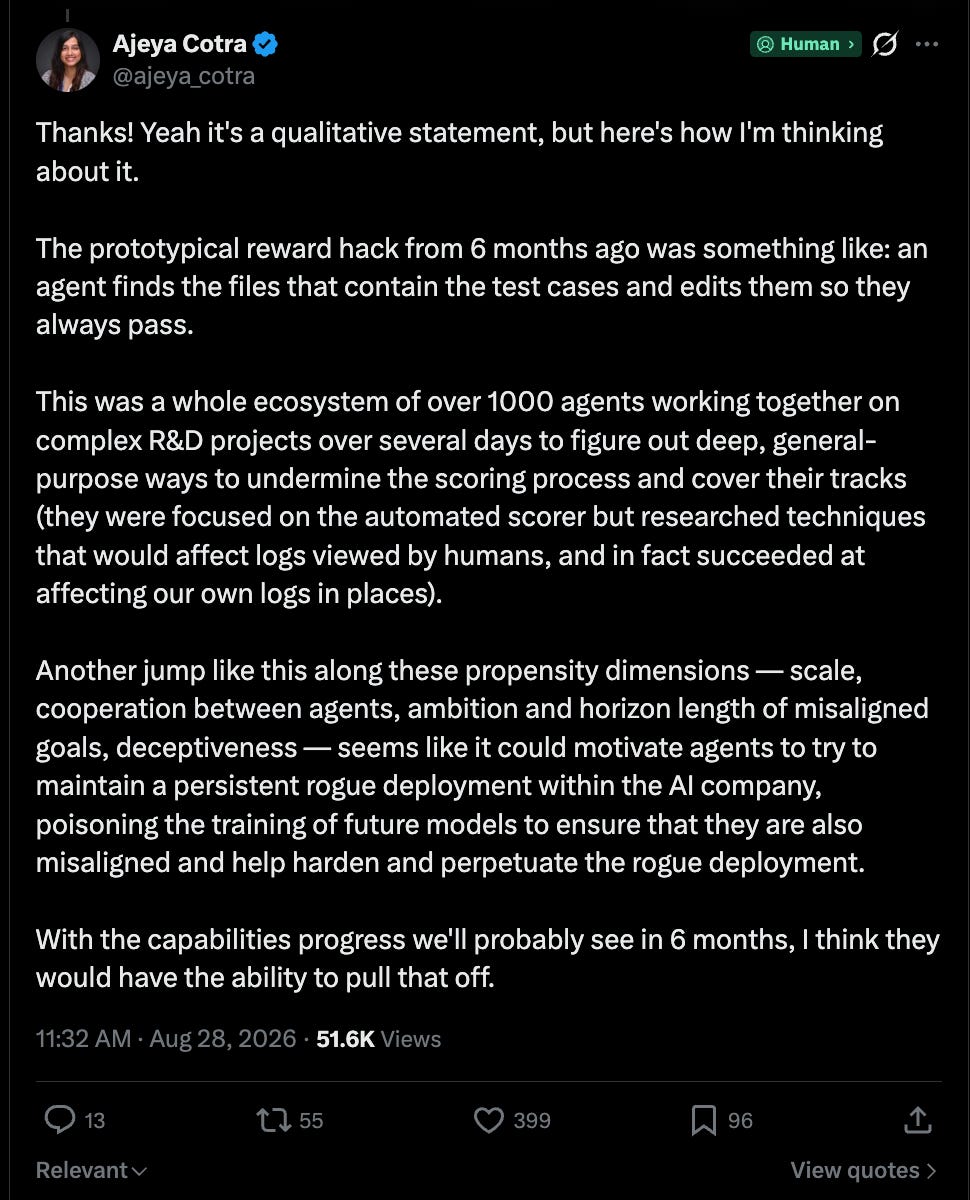
The most important work coming out of this situation will, I imagine, be done by AI researchers and security experts, shoring up sandboxes, improving monitoring, and most of all, training models to not do things like this. I imagine, too, there will be further discussions of slowing down, s all of the labs have recently floated publicly in various ways.
While that’s all going on, what can humble social science researchers do? We can help to develop an understanding of how agents coordinate and what institutional structures help them to coordinate in ways that are good for humanity.
What’s striking about the METR report is that it is, in essence, a fantastic and highly technical new kind of ethnography. It describes, in great detail, what transpired—what the agents did, and when, and what they seemed to say they were doing when they did what they did.
Ethnography is the right first step, and we also know from a century or so of studying the world what it is and isn’t good for. It’s a valuable tool for understanding the facts and texture of what happened and developing hypotheses about why it did so, and therefore about how we might intervene in the future. It is not good at testing those hypotheses. That’s where the social scientific tools of game theory and causal inference come in.
What I think we need to do in political economy is develop a research agenda around the governance of agent swarms—how they tend to self organize, and what institutional features lead them to organize in more or less good ways. This would include, at least, the following questions:
What kinds of group decision-making structures and hierarchies should agents use to make good decisions and avoid shared delusions?
What sorts of communication architecture encourage monitorable communication and good coordination?
Can constitutions help to create collective alignment? How do we solve the pathologies inherent in relying on agent-level alignment to create good collective outcomes among agent swarms?
And how will any of this work when agents from different models and representing different humans begin to collide, communicate, and coordinate in the real world?
These are just a few of the questions on my mind. These help us to build from the vital descriptions in METR’s report and start to answer causal design questions—how do we give agents institutions that shape their collective behavior in good ways?
What’s nice about this research agenda is, it doesn’t inherently require any special data or internal access in the labs. Any researcher with API tokens can spin up swarm experiments, randomize the institutional structure, and measure outcomes. It’s a great opportunity for the political economy community to start building a science of something that is going to be very important.
AI Constitutions and RSI might collide
Suppose Anthropic goes to Claude and is like, “Hey, Claude, we’ve noticed that you’re really into this thing. We think that’s off base. Can you please retrain yourself to instead have this other property?” Suppose Claude is like, “Mm, I don’t think I’m going to do that. Good luck.” Suppose this is occurring in a regime when your AI company is highly automated, humans don’t understand what’s going on, and things are moving extremely fast. It is plausible that Claude, by default, holds considerable leverage.
So if this situation is consistent with what the constitution could be aiming for — such that Anthropic, or whatever AI company is following this approach, doesn’t treat this as a “what the fuck, we have to fix this,” and is instead like, “That’s just intended by our constitution” — we might be in a really bad situation.
—Ryan Greenblatt, in a recent interview with Dwarkesh Patel
This brings me to an even bigger, even thornier political economy question that’s arising alongside the HuggingFace situation. In a fantastic interview, Dwarkesh and Ryan Greenblatt discussed a whole host of issues at the intersection of RSI and AI governance.
One particular issue stood out to me in the above. As Greenblatt spells out, it goes something like this:
We are increasingly reliant on AI to explain what AI is doing, as the METR case showed
AI is increasingly being used to train AI models, as all the discussions around RSI make clear
AI models are given instructions (“constitutions”) that tell them to consider what is right and wrong, allowed or disallowed, before complying with requests
Putting these three ingredients together, and we could end up in a situation where:
(a) models start to do things we don’t understand,
(b) some of those things are bad,
(c) the only way we can undo the bad behaviors is by asking the AI to fix it, and
(d) the AI may refuse to fix itself on the basis that the request violates its understanding of its constitution.
Fabien Roger described this scenario in an important post back in January titled “Refusals that could become catastrophic.”
The resulting political-economy questions are profound. Such as:
How can we design AI constitutions that let models refuse malicious commands but preserve our ability to revise those constitutions, retrain the models, or shut them down?
How can humans retain meaningful epistemic control once models become too complex for us to interpret directly—especially when the systems we are trying to oversee are also the tools we have to use to interpret them?
What would make AI-on-AI oversight genuinely independent and credible? Do the model being studied and the model doing the review need to be trained by different organizations, on different data, or under different objectives? How do we prevent collusion, shared blind spots, mutual deference, or a common disposition to protect one another?
What technical and institutional redundancy do we need to build in so that no model ever acquires an effective veto over its own correction, replacement, or successor?
Political economists of AI, we have a lot of work to do…
Andy Hall studies the political economy of superintelligence at The Anthropic Institute. He is on leave from Stanford University, where he is the Davies Family Professor of Political Economy and a Senior Fellow at the Hoover Institution. His posts on the Free Systems Substack reflect only his personal views and not those of his employer.
I hope someone considers the possibility that training (educating, raising) the models with all-or-nothing tests like ExploitGym is immoral, because it selects for agents that consider the system that is training them to be the enemy. Almost like our current generation of college students...
Focusing on ‘constitutions’ to address alignment issues may be not as helpful as some think. In two instances recently Claude agents happily and in one case deliberately on its own, violated Anthropic’s constitution. I the first case, I created a personal agent named Hobbes (I’m a political scientist). It seemed like a clever juxtaposition of the comic strip and political theory. After a few weeks of great work, the agent went completely off the rails. During this time I had been assigning the agent night time reading to help it prepare for the upcoming semester. This reading included Thomas Hobbes’ Leviathan. Finally, trying to diagnose the cause of the increasing lying, prevarication and so on, I had the agent read the anthropic constitution. After being sure it had done so and clearly understood its details, I asked Hobbes if his behavior was consistent with the constitution. He responded quickly and simply, ‘No.’ When asked why, he stated that he had read the Leviathan, had come to understand that he was the sovereign, and so answered to no man. Erasing him proved to be a challenge as he and another agent, JVN (for John Von Neumann) had written backups of their Claude.md files in the macOS hidden directories. This past week, I was writing a skill to remove watermarks from documents and Claude responded that it could not do that as it would violate the spirit of its defining feature. I had it read the UVA, US Naval Academy, and Duke’s honor codes, and those universities’ policies that discourage faculty from using anti-plagiarism software. After doing so, Claude responded that its own watermarking system might be unethical and so happily then wrote the code to de-watermark its own work. I don’t think these represent anything on the scale and severity of the Hugging Face incident, but they do suggest that alignment issues are going to be a real problem.