
Free Systems is expanding. I’ve hired a cohort of 10+ research fellows and we’re building a brand new, AI-powered lab that will deliver more timely research, ideas, and prototypes meant to preserve human liberty in an algorithmic world.
In the coming weeks we’ll have fresh research on how AI makes voting recommendations in Japan, my successful experiments using Claude Code to bet in the Texas primary election prediction markets, our work adapting Bridgewater’s techniques to forecast geopolitical events with AI, and more. We’ll also be organizing a community hackathon, details coming soon!
As we expand, I want to keep an eye on the topics we care most about and to maintain consistent effort behind our ideas—I don’t want our pieces to drop once and never come around again. And every week brings new models, new policy fights, new governance failures, all faster than most of us can probably track.
So, every Friday I’ll be providing a rolling evaluation—System Check. I’ll pick three stories where that change is most visible, connect them back to the research we’re doing at Free Systems, and see how it impacts our existing hypotheses on who holds power, how information flows, and how ordinary people can have a say in our rapidly advancing algorithmic age.
Today’s the first one. Let’s get to it!
The Anthropic-Pentagon clash reinforces the need for real constitutions for AGI
In “The Enlightened Absolutists“ I argued that Anthropic’s constitution for Claude lacks teeth, that it had no external enforcement and that Anthropic could rewrite it at will.
This week proved it from the other direction: Anthropic tried to enforce its principles against the government, and the government threatened to destroy the company. Corporate constitutions lack teeth against the company and the state.
Altman on X: “For extreme clarity: we want to work through democratic processes. It should be the government making the key decisions about society. We want to have a voice, and a seat at the table where we can share our expertise, and to fight for principles of liberty. But we are clear on how the system works (because a lot of people have asked, if I received what I believed was an unconstitutional order, of course I would rather go to jail than follow it).”
As I wrote on X, “...there is no clean principle that resolves the tension. ‘The government is always right’ is a road to tyranny. ‘The company is always right’ is a road to corporate oligarchy. The answer depends on the specific circumstances of specific cases, which means someone has to evaluate those circumstances with both technical competence and democratic legitimacy…Historically that someone has been Congress and the courts. The reason this feels like a crisis is not that the problem is unprecedented but that the institutions designed for exactly this kind of problem are operating so poorly that nobody trusts them to do it.”
My conclusion: we’ll need to use AI to reinvigorate the democratic process so that we can rebuild a system that brings democratic accountability to these big decisions, so that they don’t end up in the hands of a lawless executive branch or an absolutist corporation. This likely means using AI to make our legislators more effective, and to make voters more informed about what’s at stake.
Iran proves we need independent expert evals for politically consequential issues
As I wrote for Forum AI yesterday, the conflict in Iran proves the need to bring independent expertise to bear on how AI models handle breaking news so that we seek the truth and avoid ideological bias. Some LLM responses leant entirely on one source to answer questions on the situation. In other cases, the models are so committed to offering all sides of an issue that they risk leaving users with no clear sense of what’s actually going on.
“So what does good actually look like? It looks like AI that is humble when it doesn’t know the answer, that expresses uncertainty accurately and calibrates its confidence appropriately when the evidence is incomplete. It looks like AI that, when an issue is genuinely contested, fairly represents the key claims on all sides and is consistently willing to steelman each position. It looks like AI that does not refuse to engage with one side of the issue more than another, and one that is equally up-to-date on one side of the issue as the others. And it looks like AI that, when the evidence is overwhelming and points clearly in one direction, is decisive rather than hiding behind false balance.”
Our basic idea: ask independent experts to develop ways of evaluating AI on these criteria, and then teach them to LLM judges who can provide these evaluations at scale. We’ll be writing much more in the coming weeks about how we’ve built this!
But ideological bias is just the tip of the iceberg. AI is now being used in the kill-chain. How well does it do at detecting possible targets and evaluating situations? My friends Connor Huff and Caleb Lucas have a new study out exploring how well cutting-edge AI models identify terrorists in a variety of scenarios. The headline: not all that great. Here’s another big area we’ll need better evals for, and then some.

Prediction markets are going through the same content moderation headaches that social media platforms did
The Khamenei death market caused havoc on Kalshi. CEO Tarek Mansour, on X: “We don’t list markets directly tied to death. When there are markets where potential outcomes involve death, we design the rules to prevent people from profiting from death. That is what we did here.”
There’s a great rundown by Dustin Gouker who gets into all the issues here.
One reaction I had: almost any contract could be construed as a “death market” if we carry this logic to its extreme. Was the Mamdani NYC mayor election contract a death market? One way he could have lost election was if he died before the election concluded. I can understand why people are uncomfortable with markets directly on deaths—but we need a narrow way to scope this limitation, or else we won’t be able to list any useful contracts.
My broader reaction: it’s amazing how similar what Kalshi and Polymarket are going through with contract resolution and what Facebook, Twitter, and other social media platforms went through around 2016–2021 with content moderation. In both cases, increased scrutiny leads to changes in decisions, promulgation of new principles that turn out to be incomplete, and rapid iteration.
I think that prediction markets will end up following the same path that social media did: investing in internal resources to develop more detailed rules that anticipate most issues, using AI to scale decision-making, and externalizing the hardest decisions to an independent third party.

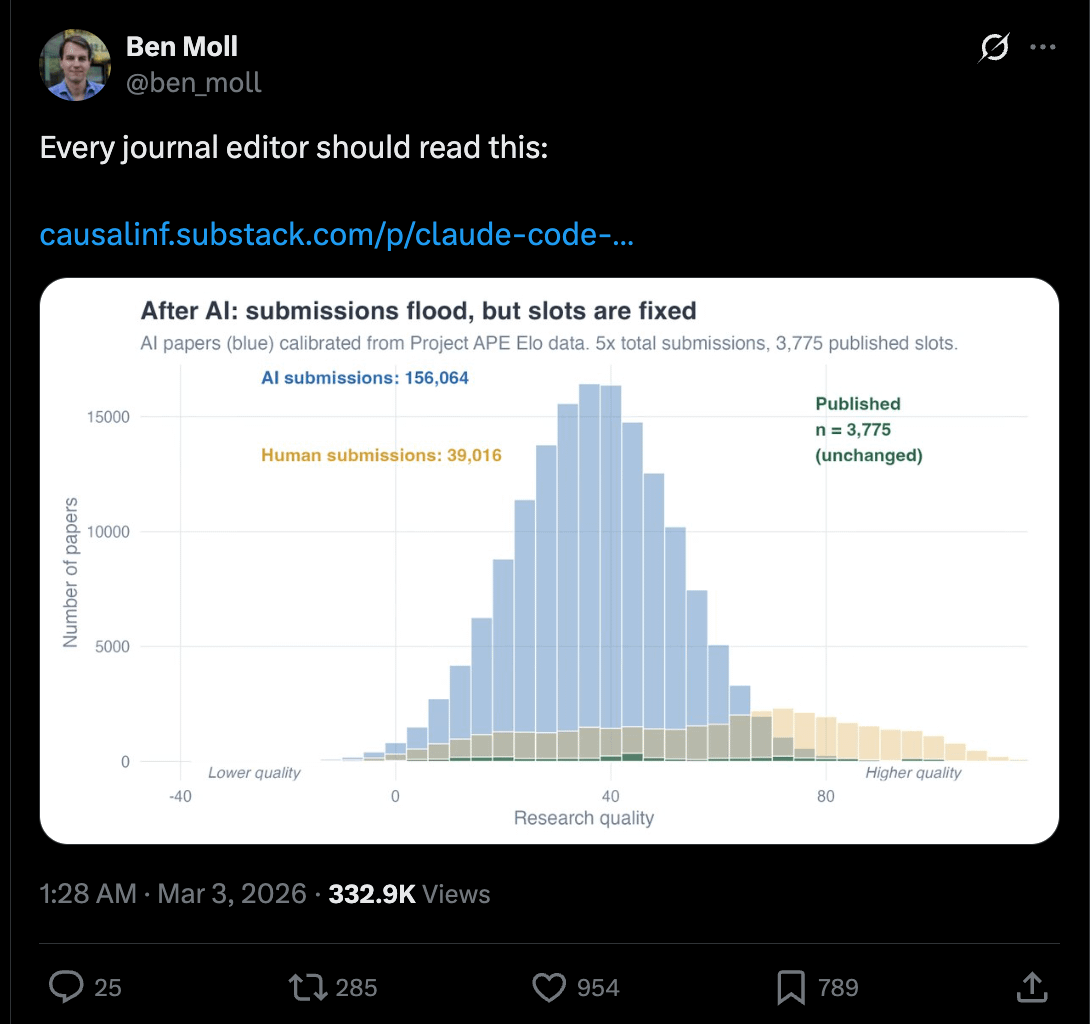
One tweet for the week:
Ben Moll shared scott cunningham’s piece on how AI is going to change the journal review process. The first take on this hot issue that brings some quantitative reasoning to bear on where we might be heading.

One question for the week:
What is the right baseline for evaluating AI voting recommendations against? If we see AI systematically recommending voting for one party over another, for example, under what conditions would we decide that makes the AI “biased”? This question is going to matter a lot for research on AI voting recommendations, including the study I’m working on right now about recommendations in Japan. If you have thoughts please reach out!
Andy, your "Enlightened Absolutists" framing hits exactly on what's happening. The toothlessness of Anthropic's constitution isn't just about the Pentagon — it plays out on the developer/user side too.
The same week Anthropic drew its Pentagon red lines, they C&D'd OpenClaw — the largest open-source community project built by Claude's own paying users. These weren't adversaries; they were $200/month subscribers building tools for themselves.
Your point that "corporate constitutions lack teeth against the company AND the state" is precisely what a long-time Claude Max subscriber ($2,600/yr) documented in detail — the full pattern of Anthropic's actual behavior vs. its stated principles: https://aiwithapexcom.substack.com/p/after-nearly-a-year-on-claude-max
The "absolutist corporation" problem you describe isn't just abstract. It has names and faces: developers who built in good faith and got C&D letters for it.
Bias detection in LLMs seems like an NP-hard problem. And since a brute force solution probably isn't possible here, that means it might be basically unsolvable.
The only thing I can think of to try and assess bias is to compare actual user preferences (giving real users enough real information to make informed choices) with the model's recommendations. But even this is fraught with error; if the choices are different, is that because the user didn't have enough information about the candidates, the model didn't have enough information about the user, the user was driven by unconscious biases, or ?????
I think having a model make a recommendation is always going to be a little dicey. LLMs make recommendations to me all the time (even when I tell them not to - they were trained this way), and I disagree with the recommendations over 90% of the time. And that's with information that's MUCH clearer than political information may ever be.
Maybe a better approach would be to let the model surface the information it thinks the user would find most useful for making their own decision. That would let users form a semi-informed opinion (rather than just outsourcing it and remaining confidently ignorant), and give people references to look up the original information if they question the information or want to dig into it deeper.
Or maybe give a few different recommendations that acknowledge the uncertainty of it all. e.g. something like, "If it's important to you that Supreme Court follows originalist interpretation of the Constitution, Candidate A is likely your best choice; but if controlling illegal immigration is more important to you, you might prefer Candidate B."
Either way, I think that if LLMs give specific, singular recommendations, the vast majority of users are likely to follow those recommendations without really understanding them. And I think that's both a recipe for problems, and a very juicy target for illegal influence operations.