
Inside The Roblox Casino
The gambling mechanics hidden inside children’s games
“The California Penal Code contains several provisions that prohibit operating a game of chance in which the player can win or lose a “thing of value.” These provisions were drafted a long time ago, and they are very difficult to understand. The question presented here is whether a website that enables people to gamble away their Robux—the virtual currency that kids spend to play games on the Roblox platform—is operating games of chance in which players can win or lose a thing of value…The answer is yes.”
–United States District Judge Vince Chhabria, recent ruling in Yaniv De Ridder et al v. Roblox
“It’s gambling. It just is.”
That’s Mick Mulvaney—President Trump’s former chief of staff—explaining why he is launching a coalition called “Gambling Is Not Investing.” His target: prediction markets like Kalshi and Polymarket. Mulvaney’s group will lobby for prediction markets to be regulated by state gambling laws.
His intervention lands in the middle of the broader reckoning that kyla scanlon describes. Gambling has gone from a side habit to a culturally central practice. Prediction markets sharpen that reckoning because they force an unusually simple question: when exactly does an activity cross the threshold from speculation or random fun into outright gambling?
Long a magnet for cultural panic about addiction, manipulation, and predatory design, video games are now facing their gambling reckoning too. New York’s attorney general just sued Valve, alleging that its loot boxes function as illegal gambling. Last year, the FTC banned Genshin Impact from selling loot boxes to children. And in the ongoing Soucek v. Roblox litigation, Judge Vince Chhabria has already allowed negligence and California unfair-competition claims to proceed against the company for allegedly facilitating child gambling, though the ultimate outcome of that case is still unclear.
That is what makes this existential for Roblox. The question is no longer just whether the platform hosts manipulative games. It is whether one of the core economic systems through which children experience Roblox is, in legal terms, edging into gambling. Roblox reported 144 million daily active users in Q4 2025; among users who had completed its new age-check by January 31, 35% were under 13. If courts or legislatures start treating Robux-based wagering as gambling, Roblox is defending more than its reputation. It is defending the legality of a central part of its ecosystem.
Playing thirty Roblox games in one week
In my last piece on gaming, I argued that Roblox is one of the first algorithmic nations our children inhabit: a place where they learn what is fair, what is rewarding, and how digital markets feel from the inside. Roblox at its best is extraordinary, a place where kids can create and play imaginative and fun new games, learning as they go. But that is exactly why its incentive structure matters so much.
And the only real way to understand that structure is to go there. You can read lawsuits and policy papers, but they flatten the experience. To understand what Roblox is teaching our kids, you have to log in, play the games, feel the loops, and watch how the system tries to pull you back. I had already spent many hours doing that for one game, Grow a Garden. What I still lacked was a way to tell whether what I was seeing there was an outlier, or par for the course.
That’s when I met Branden, a fellow political scientist who also happens to be a game developer and Roblox pro.
Branden volunteered to play not just one game, like I had, but thirty games.
And he didn’t just report a few anecdotes like I had, he systematically captured data—as well as videos, and screenshots—on all the different strange things he encountered in the games. The result is the most up-to-date taxonomy of the gambling mechanics present in the most popular new Roblox games, as well as their prevalence.
What we found: gambling-like mechanics are both far more pervasive than I’d realized in my initial exploration, and exist in a remarkable array of forms, many of which are noticeably more exploitative than the versions I previously documented.
By game ten, the pattern becomes predictable. A spin wheel within the first thirty seconds—sometimes before you’d even moved your character. A shop populated with items whose relative value was impossible to compare. A notification that something was growing or earning while you were away, a gentle tug designed to pull you back tomorrow.
By game twenty, we were calling out mechanics before they appeared on screen. The question had stopped being whether a given mechanic would show up and started being how long it would take.
By game thirty, what had started as a research exercise felt like touring a single factory. Not just the same underlying architecture, but often the same surface too: the same brainrot characters, the same blocky UI conventions, in some cases assets that looked outright duplicated. The variation that does exist — a mining theme here, an escape theme there — is surface-level cosmetics hiding increasingly similar revenue machines.
Above: My character taking in the mindless automated sweatshops inside My Mining Brainrots, a game where our children, many under the age of 10, commit themselves to hours of drudgery in the digital salt mines for the uncertain prospect of digital rewards
Games like My Mining Brainrots, the brainchild of the studio Brainrot Games 67 that has been played almost 30 million times, are jam-packed with mechanics that deceive children while leaving them enticed to continue spending money in pursuit of elusive payouts.
I challenge anyone to log into Roblox, play My Mining Brainrots, and conclude that this is something 8-year-olds should be playing.
Why online games sometimes look like gambling
Understanding why gambling mechanics are so prevalent in online games comes down to one insight from behavioral psychology. There is a critical difference between randomness as a design challenge—where players develop skill responding to uncertain situations—and randomness as a reward schedule, where players simply pay and wait to see what they get.
For the former, Raph Koster’s A Theory of Fun for Game Design (2004) argues that the deepest fun arises from learning and mastery; the brain encountering a new pattern, working to solve it, and rewarding the player when comprehension clicks.
However, the latter maps onto what B.F. Skinner identified as variable-ratio reinforcement: rewards arriving after an unpredictable number of responses, producing behavior that is uniquely persistent and resistant to extinction. It’s the same principle that makes slot machines hard to walk away from, and subsequent research has confirmed that loot boxes share the same psychological structure.
This includes work looking specifically at Roblox, documenting gambling-like mechanics with a similar method to ours in the past and interviewing children to document both their lack of understanding of these mechanics, as well as their anguish when they’re taken advantage of in the game.
Some major studios took notice. Epic Games removed blind loot boxes from Fortnite in 2019; Overwatch 2 did the same when it relaunched in 2022, though it later brought them back in a new form. But the fact that billion-dollar franchises can potentially thrive without randomized monetization makes the prevalence of these mechanics on Roblox a choice, not an inevitability.
Gambling in Roblox: A New Taxonomy
To measure gambling, we need to agree on what it is. Mulvaney’s view on prediction markets and sports betting is that “if it walks like a duck and quacks like a duck, it’s a duck.” What about video games? Gambling, the Legal Information Institute tells us, is: “when a person bets or risks something of value (like money) based on a chance outcome that is out of their control or influence with the understanding that they will either gain increased value or lose their original value determined by the specific outcome.”
The video game litigation described above is forcing courts to operationalize that definition for a new context. Across the Roblox, Valve, and Genshin Impact cases, the core empirical questions are remarkably consistent:
Do the mechanics in question involve wagering “something of value” on an outcome determined primarily by chance?
Are the odds disclosed or obfuscated?
Are the targets children, and does the platform take adequate steps to protect them?
And does the bundling of individually defensible mechanics—a spin wheel here, a rarity tier there—produce a composite experience that functions as gambling even if no single element crosses the line on its own?
That last question is the one existing law struggles most to answer—and the one we wanted to explore. A regulator or judge looking at any single mechanic in isolation can usually find a way to characterize it as benign. But when six, eight, or ten of these mechanics are fused together in a single game aimed at children, something qualitatively different emerges. Measuring that requires a systematic framework rather than case-by-case litigation.
Inspired by this backdrop, we developed a taxonomy of twelve distinct gambling-like mechanics, sampled games from Roblox’s own trending charts, played through each one on a fresh account, and tagged every mechanic present within the first gameplay loop.
Someone can certainly quibble with which of these mechanics truly constitute “gambling,” but each of them shares elements of randomness, desire, and manipulativeness that are hard to justify for young children even if they might be OK for older children or adults.
What emerged wasn’t a story about a few bad actors. The median game in our sample bundled eight of the twelve mechanics. Every game published in 2025 or later had at least five. The pattern is so consistent it looks less like individual developer choices and more like a template—an output of the platform’s own incentive architecture.
The twelve mechanics are:
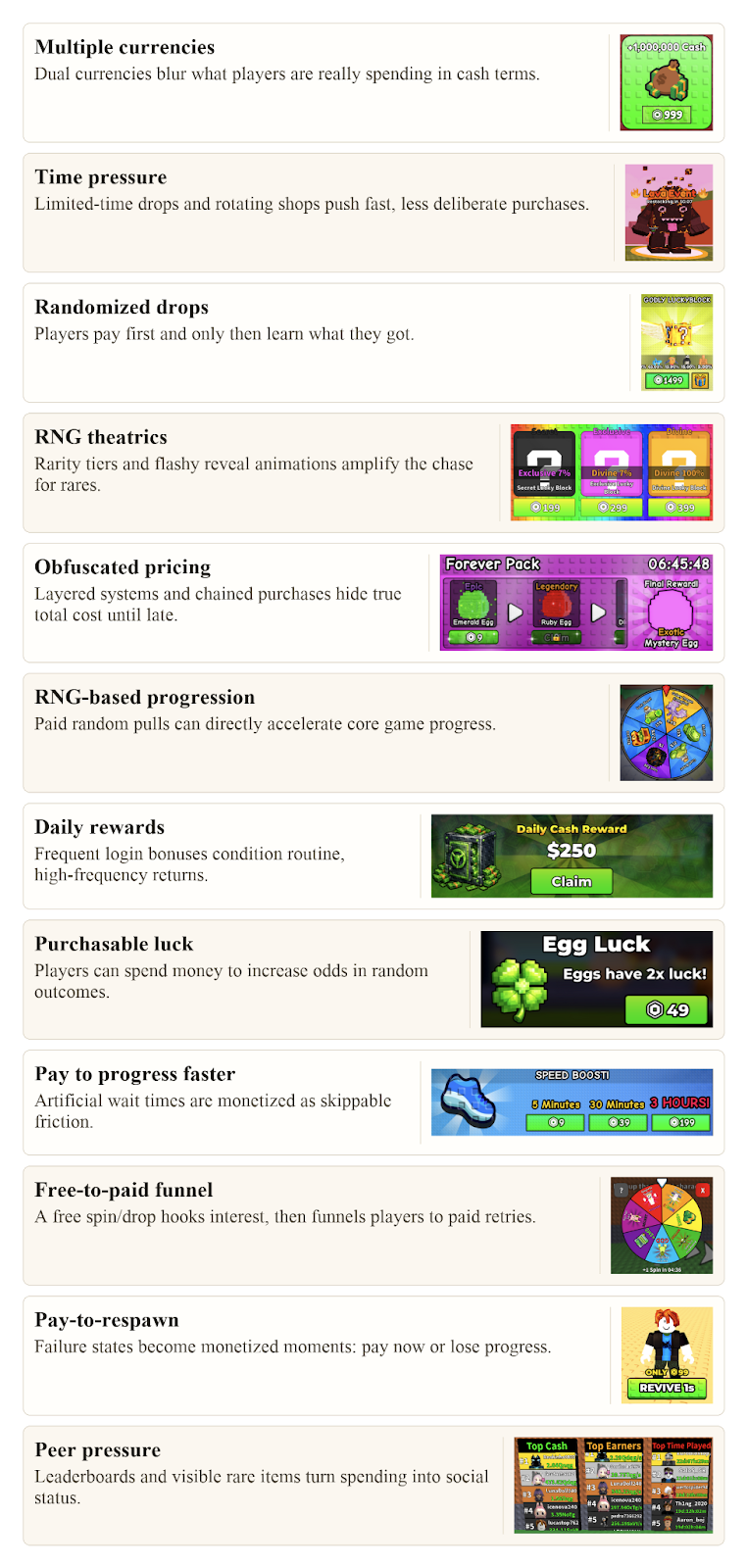
The Numbers
We started where any child would: the Top Trending chart, the first thing you see when you open Roblox’s web interface. These are the games that have grown their playerbase fastest over the prior two weeks—the platform’s own signal of what’s hot. We drew a random sample of thirty, created fresh accounts, played through one full gameplay loop of each, and applied our twelve-tag checklist.
The results were striking. The median game in our sample had eight of the twelve mechanics present within the first gameplay loop. Several games scored ten or above. The number that really grabbed our attention was that the average game published in 2026 had 9.5 of these mechanics, up from 4.6 in 2025.
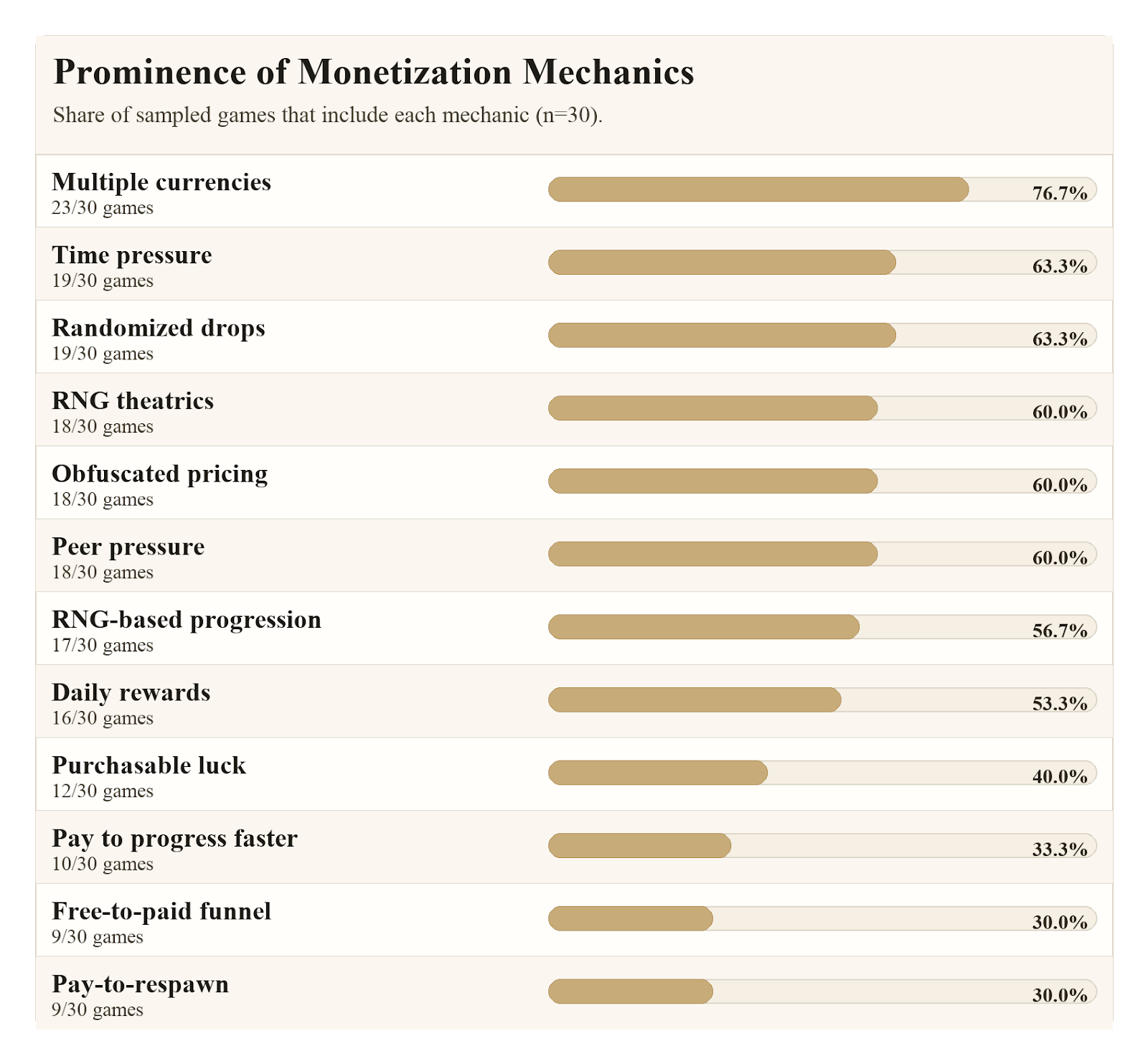
Certain mechanics clustered together so reliably they functioned almost like a signature. Multiple currencies, time pressure, and randomized drops appeared as a base layer across the sample—the foundation on top of which other mechanics were stacked. Purchasable luck and RNG theatrics appeared together in almost every game that had either, suggesting they are understood by developers as a package, rather than individual choices.
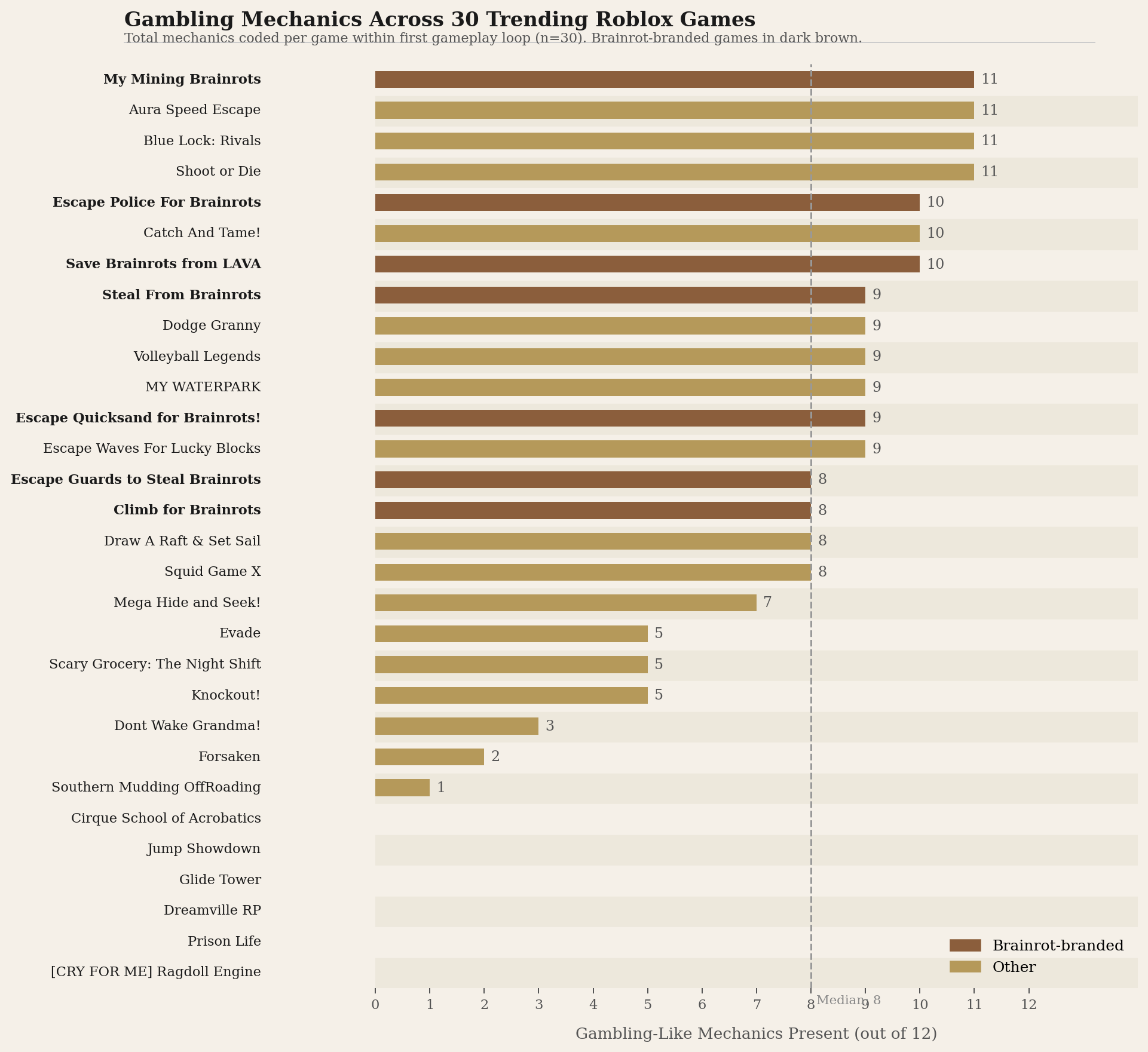
The six games with zero tags include historically popular titles like Prison Life (created 2014) and Ragdoll Engine (created 2020). All but one, Cirque School of Acrobatics (created December 2025), predate the monetization and discovery systems Roblox has built out since. Their presence suggests this pattern isn’t inherent to the platform, or to games aimed at children, but rather the output of a particular set of incentives.
My Mining Brainrots: Inside the extraction engine
The sharpest illustration of where these trends are heading is the “brainrot” game format, which has surged in popularity since mid-2025. Brainrot culture more broadly is an aesthetic expression of anarchic and anti-serious internet culture: deliberately chaotic, proudly meaningless, and optimized for engagement.
What our data shows is that the games wearing that aesthetic are also structurally the most aggressive. These games share a basic structure: the player performs some repetitive action — mining, climbing, escaping — to collect “brainrot” characters of varying rarities. Rarer characters earn more in-game currency, which funds upgrades and further collection. The format is simple to clone and, as our data shows, comes pre-loaded with monetization mechanics.
In our sample, games with brainrot branding had a median of nine mechanics. Games without it had a median of five.
The worst offender in our sample was My Mining Brainrots, developed by Brainrot Games 67—a shadow studio derived from the longtime developer Wonder Works. Along with Blue Lock: Rivals, it was the only game to contain eleven of the twelve mechanics we coded (the sole missing element was pay-to-respawn, because neither game has a loss condition).
To help you see and experience all these mechanics, Branden recorded a video that walks you through it all. Check it out!
The first thing we see when we open the game is a notification that our brainrots earn money while offline. This is not incidental. The offline earnings mechanic, popularized by Grow a Garden, is likely a direct response to the Creator Rewards system Roblox implemented in July 2025.
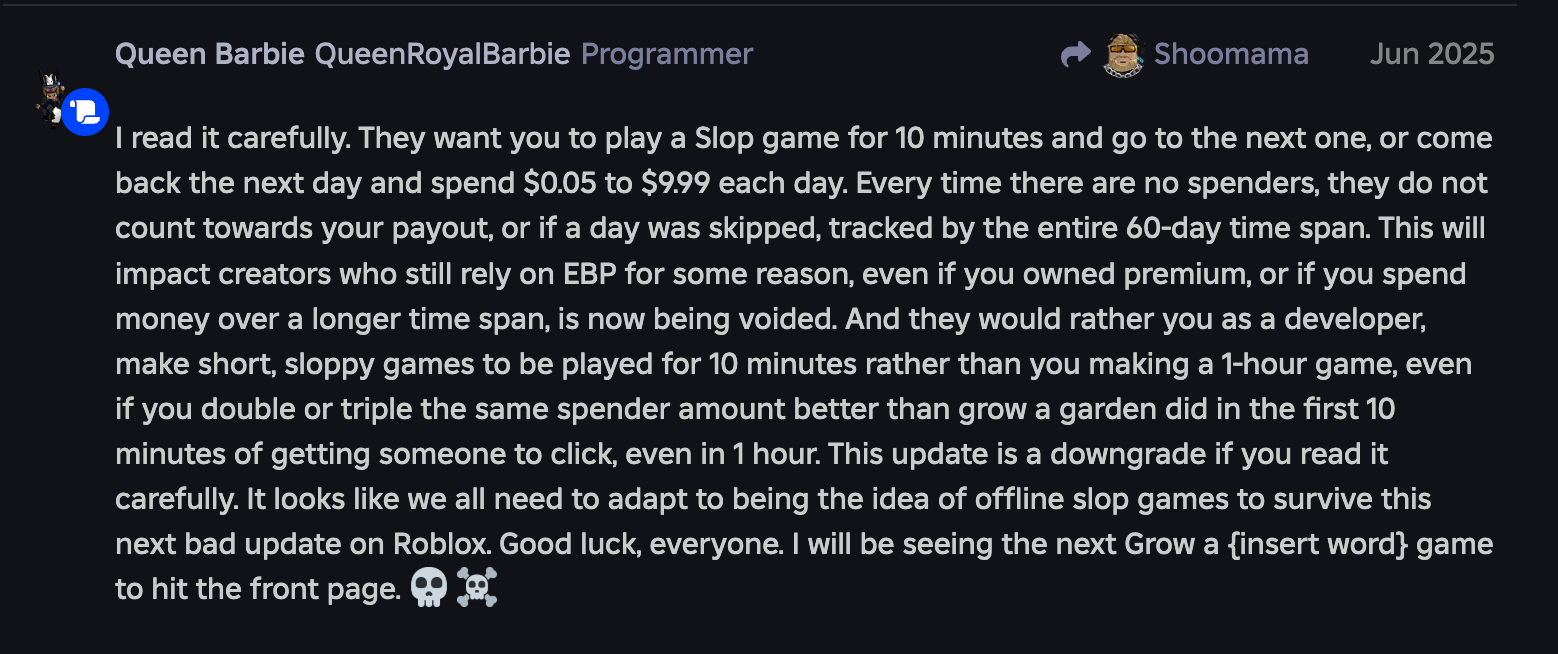
Under Creator Rewards, developers receive 5 Robux per day when their game is one of the first three an “Active Spender” plays for ten or more minutes. If our characters are earning currency while they sleep, we are more likely to open the game first thing in the morning to collect—making the developer’s game the first session of the day, in a short burst, exactly matching the payout structure. Where the old algorithm rewarded long sessions, Creator Rewards rewards short, daily returns. My Mining Brainrots is engineered for that.
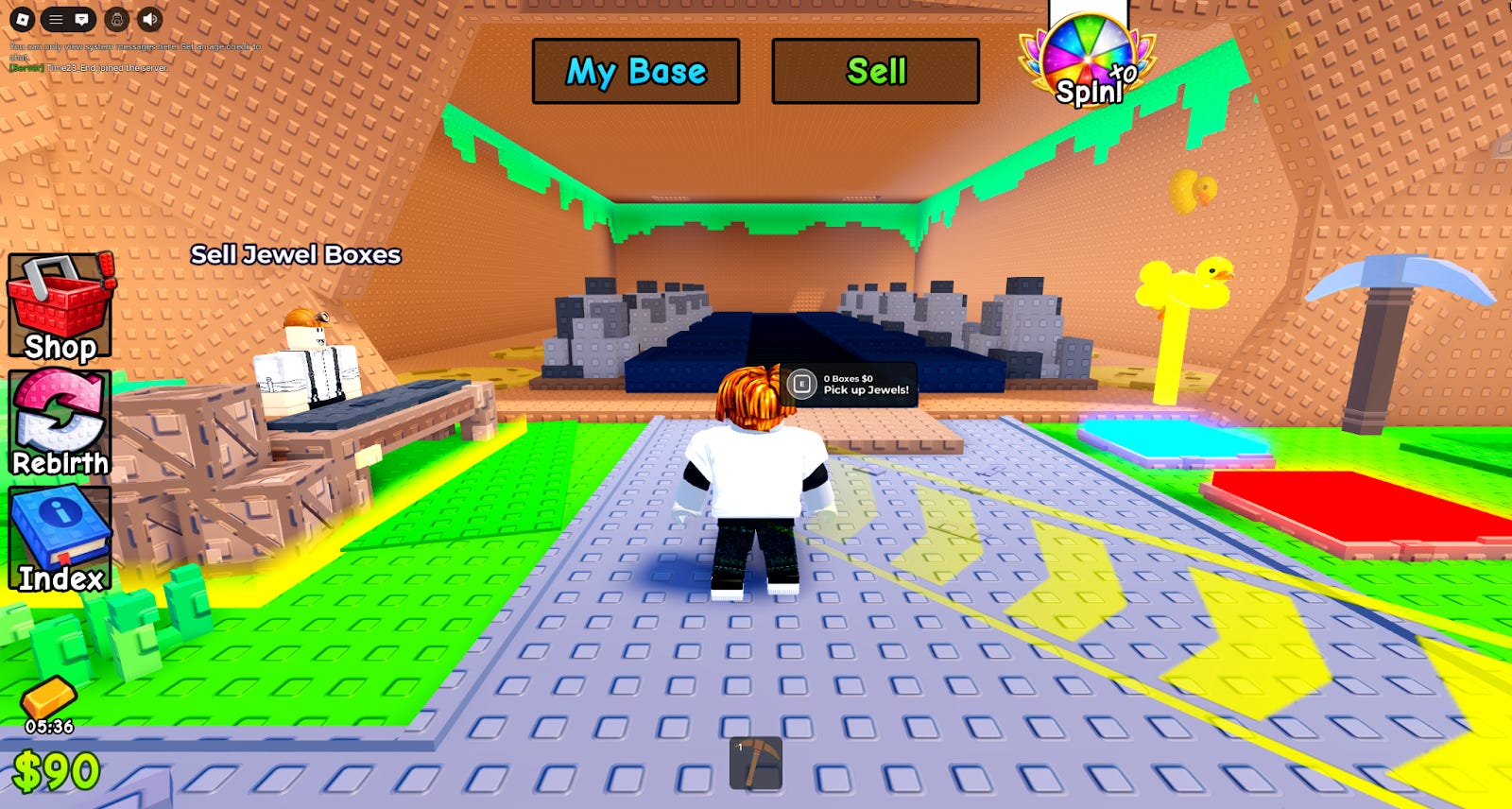
Before we even move our camera, we are presented with four opportunities to spend money. On our right, two rare pickaxes are shown, which speed up the intentionally slow gameplay loop of mining. Brainrot-adjacent games often depend on slow, boring mechanics which we naturally want to speed up, some even as mundane as waiting for an egg to crack or a crop to grow.
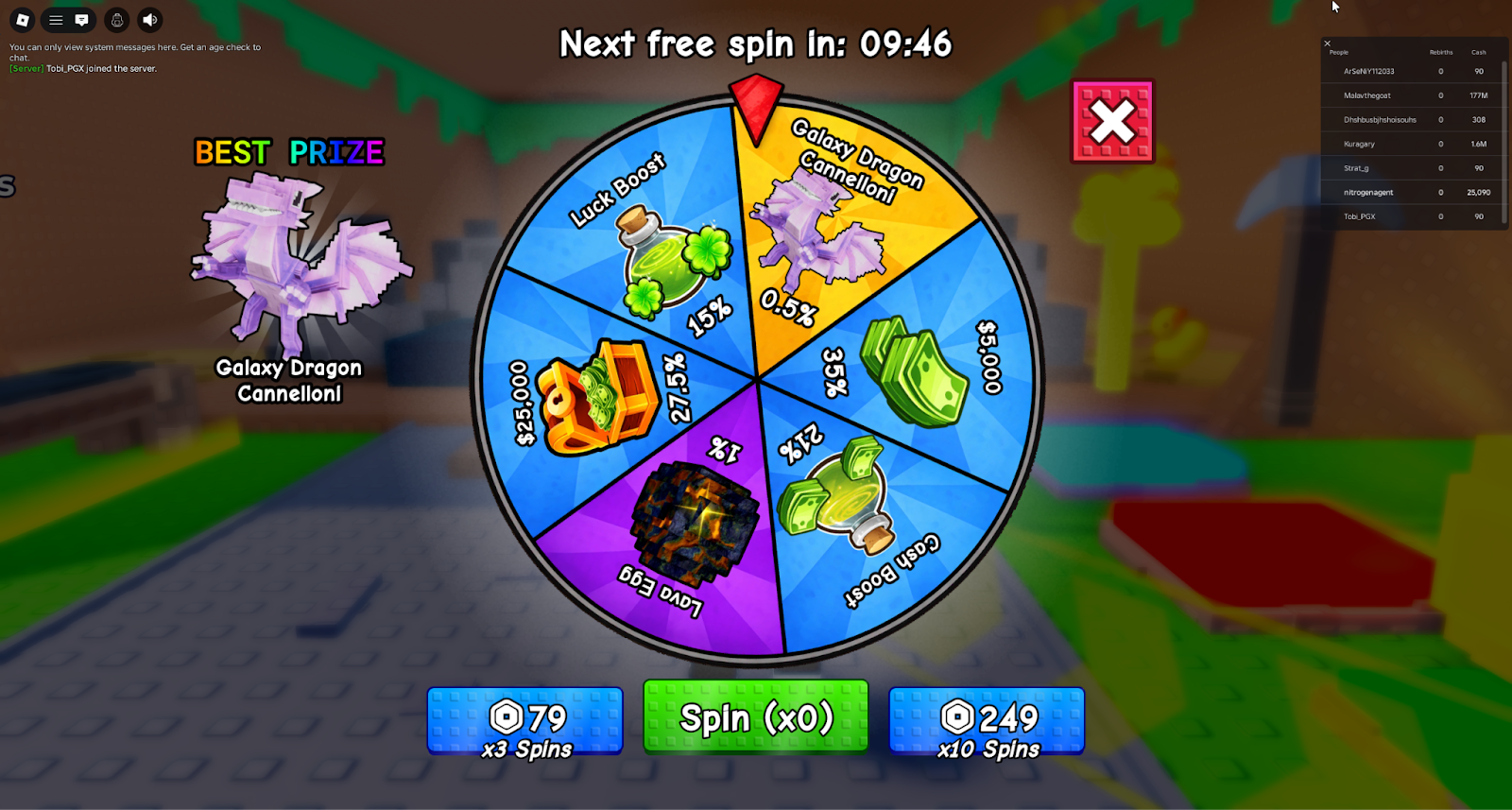
Next, the spin wheel, the most common recurring mechanic in our sample. In My Mining Brainrots, we earn a free spin every ten minutes! We can purchase spins individually, or in groups of 3 and 10. The “best prize” rotates – the value of which is unclear beyond belonging to the gold category and having the lowest odds. This is an example of trickling us with free samples of a paid mechanic in the hope we’ll return and spend more money.
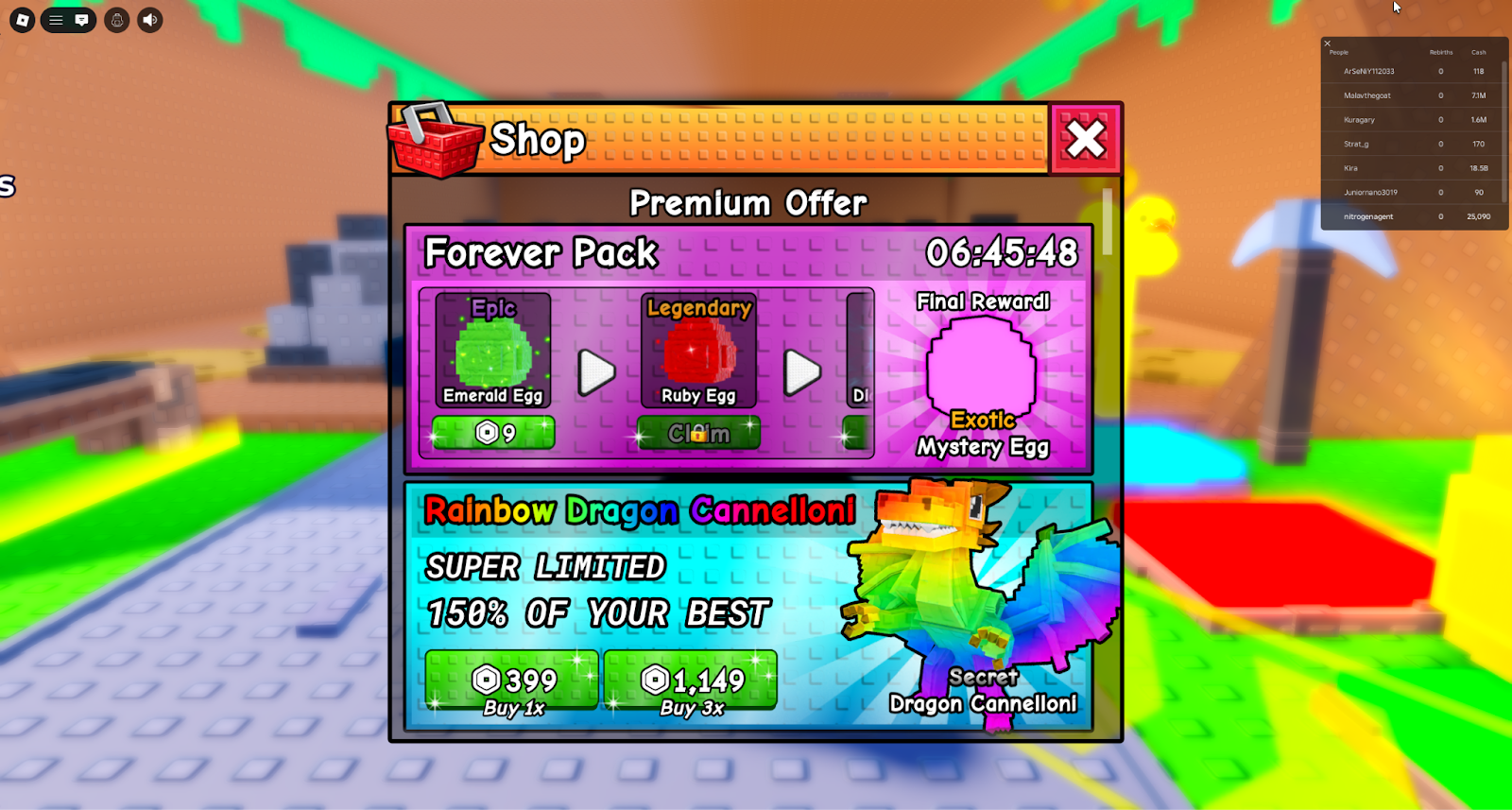
Third, the shop. Here is the most exploitative mechanic we identified in the sample – the chained purchase. Despite the arrows suggesting some kind of interactable interface, the cost of the “Forever Pack” is hidden from us. This information is drip-fed to us at each successive stage of purchasing. At the time of our sample, the true cost of the pack was 252 Robux, despite the first purchase costing only one.
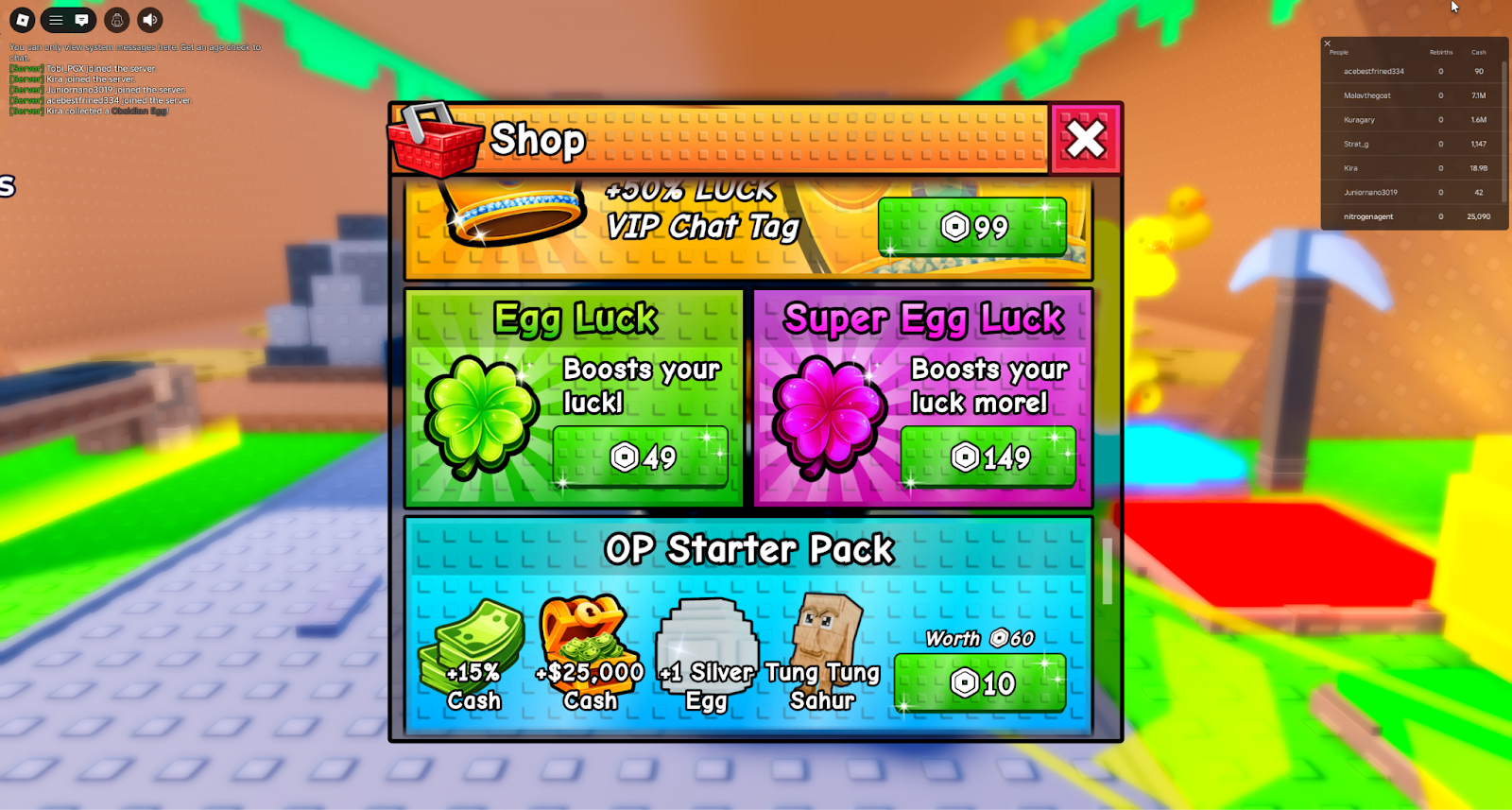
Looking deeper in the shop, we can purchase boosts to our luck (the amount of the actual perk is undisclosed). We can also purchase the “OP Starter Pack”, which is identical to the normal “Starter Pack” offered to the player after only minutes of entering the game. We can even purchase perks to the egg-hatch speed – another way of speeding up an intentionally dull mechanic.
One recurring theme is the plethora of purchasables that make it difficult for an average player like us to compare values. Maybe it’s more effective to purchase cash outright in one of the game’s five Robux-for-cash bundles, but maybe it’s more effective to purchase Egg Luck and go for rare rolls, or buy the OP Starter Pack to unlock Tung Tung Sahur. This is further complicated by the several resources that can be bought, including spins, eggs, lucky boxes, cash, luck, and Robux.
My Mining Brainrots is unusually complete. Nearly every mechanic in the taxonomy appears because each one patches a gap the others leave. The free spin feeds our desire, and the cooldown creates impatience. The paid spin converts impatience into spending. The luck purchase makes a child feel that a bad outcome was their fault for not spending enough. The rarity tiers give the whole system a goal that can never quite be reached. Offline earnings bring us back every morning for a chance to repeat the process. Bundle these mechanics and you have something qualitatively distinct from the era of loot boxes and rotating shops that games like Fortnite and Overwatch normalized in the 2010s.
Explanations and Recommendations
The central finding of our research is simple: gambling-like mechanics aren’t scattered randomly across Roblox’s trending charts. They’re concentrated, they cluster together, and they’ve intensified sharply in games published after Roblox overhauled its Creator Rewards system in 2025. This is in part a story about incentives, and that means the solutions have to operate at the level of incentives too.
What Roblox should do
The most important thing Roblox can do is prove that alternatives work.
The conventional wisdom among Roblox developers right now seems to be that you need the existing stack—spin wheels, purchasable luck, offline earnings, chained purchases—to compete on the trending charts. To quote one developer, “They want developers to make games that exploit the attention of younger audiences by producing slop after slop.” No one has yet invested in testing that at scale.
Roblox is uniquely positioned to change that. It could launch design competitions—with meaningful prize pools and guaranteed discovery placement—challenging developers to build the most engaging game possible with a gambling-mechanic score of zero.
It could commission an open-source library of starter templates demonstrating how battle passes, direct cosmetic purchases, narrative progression, or subscription access can sustain a game without spin wheels or randomized drops.
It could fund a cohort of developers to spend six months prototyping non-extractive games, publish the results, and share what worked. The point is to lower the cost of experimenting with alternatives and to generate real evidence about whether they can compete, all without dictating game design from the top down.
This matters because even a perfectly reformed algorithm cannot surface games that don’t exist yet. Roblox needs to help developers imagine and build the next generation of children’s games, not just tweak the ranking system that sorts the current ones.
On that ranking system: our results suggest that the shift to Creator Rewards in July 2025 helped usher in the current brainrot era. The offline earnings mechanic—now ubiquitous in our sample—is a direct engineering response to that payout structure. Roblox has acknowledged that its previous algorithm created its own problems; it should now examine honestly whether the current one is doing the same, and be willing to keep adjusting.
To prop all of this up, Roblox should measure the problem systematically. Right now, neither Roblox nor anyone else tracks the prevalence of gambling mechanics across the platform’s most popular games at scale. While the platform’s rules already place some limits on gambling and mandate transparency, our data suggests these rules are both incomplete and not well enforced.
Our taxonomy is a first attempt, but Roblox has the data, the engineering capacity, and the platform access to do this continuously. Publishing that data - something akin to the nutritional labels that food regulators require, applied to game design - would be a meaningful act of transparency and the foundation for everything else.
What policymakers should do
The legal framework for addressing gambling in games is a patchwork of statutes written long before Robux existed, and courts are straining to apply them. Judge Chhabria’s ruling that Robux qualify as “things of value” under California’s gambling statutes was important, but he also used the opinion to call for legislative clarity, noting that the old provisions need updating “especially as online games played for various forms of virtual tokens and currencies become increasingly common.” He is right.
Policymakers should start with transparency. Platforms like Roblox should be required to disclose, in a standardized and machine-readable format, the gambling mechanics present in any game accessible to minors: the odds of randomized drops, the true cost of chained purchases, the presence of purchasable luck or RNG-based progression. This should not be left to voluntary industry commitments, which have repeatedly proven insufficient. It should be a regulatory requirement. This could be modeled on a mix of existing disclosure rules and stricter gambling-law approaches in Europe, including jurisdictions that have treated certain paid loot boxes as unlawful gambling and EU proposals aimed at games accessible to minors
Beyond disclosure, policymakers should authorize and fund the use of AI agents to audit games at scale. The taxonomy we developed required a human researcher to play each game manually, an approach that cannot keep pace with a platform where thousands of new games launch every week. Automated agents capable of navigating a game’s first loop, detecting monetization mechanics, and flagging games that exceed a threshold score would allow regulators to monitor platforms like Roblox, the App Store, and Google Play continuously rather than relying on after-the-fact litigation. The technology for this kind of automated auditing is maturing rapidly, and regulators should be investing in it now. We’ll be working on prototyping it for a future piece.
Finally, some practices should simply be prohibited when the audience is children. The chained purchase, in which the true cost of a bundle is hidden and revealed only after each successive payment, is straightforwardly deceptive. No amount of disclosure fixes a mechanic whose entire purpose is to defeat informed consent. Purchasable luck, in which a child can pay to improve their odds in a random draw, is a direct analog to the variable-ratio reinforcement with purchased advantage that gambling regulators have long recognized as especially dangerous. These mechanics should be banned in games accessible to players under sixteen, just as the EU’s proposed Digital Fairness Act contemplates for loot boxes.
Teaching children to build, not extract
Prediction markets, sports betting, loot boxes, spin wheels are not separate phenomena. They are, arguably, different expressions of the same underlying logic, that the most efficient way to extract value from human attention is to wrap it in the aesthetics of chance.
This requires carefully building for incentives, and incentives can be changed. The question for those in Roblox’s algorithmic nation is whether we will change those incentives before a generation raised inside the machine decides that extraction is just how the world works.
 | A guest post by
|
I’d like to see surveys of kids before/after playing games. What characteristics of games are predictive of positive wellbeing?