
Free Systems is on a roll
How we're expanding, the status of the 100x research institute 6 months in, and how the slopocalypse is playing out.
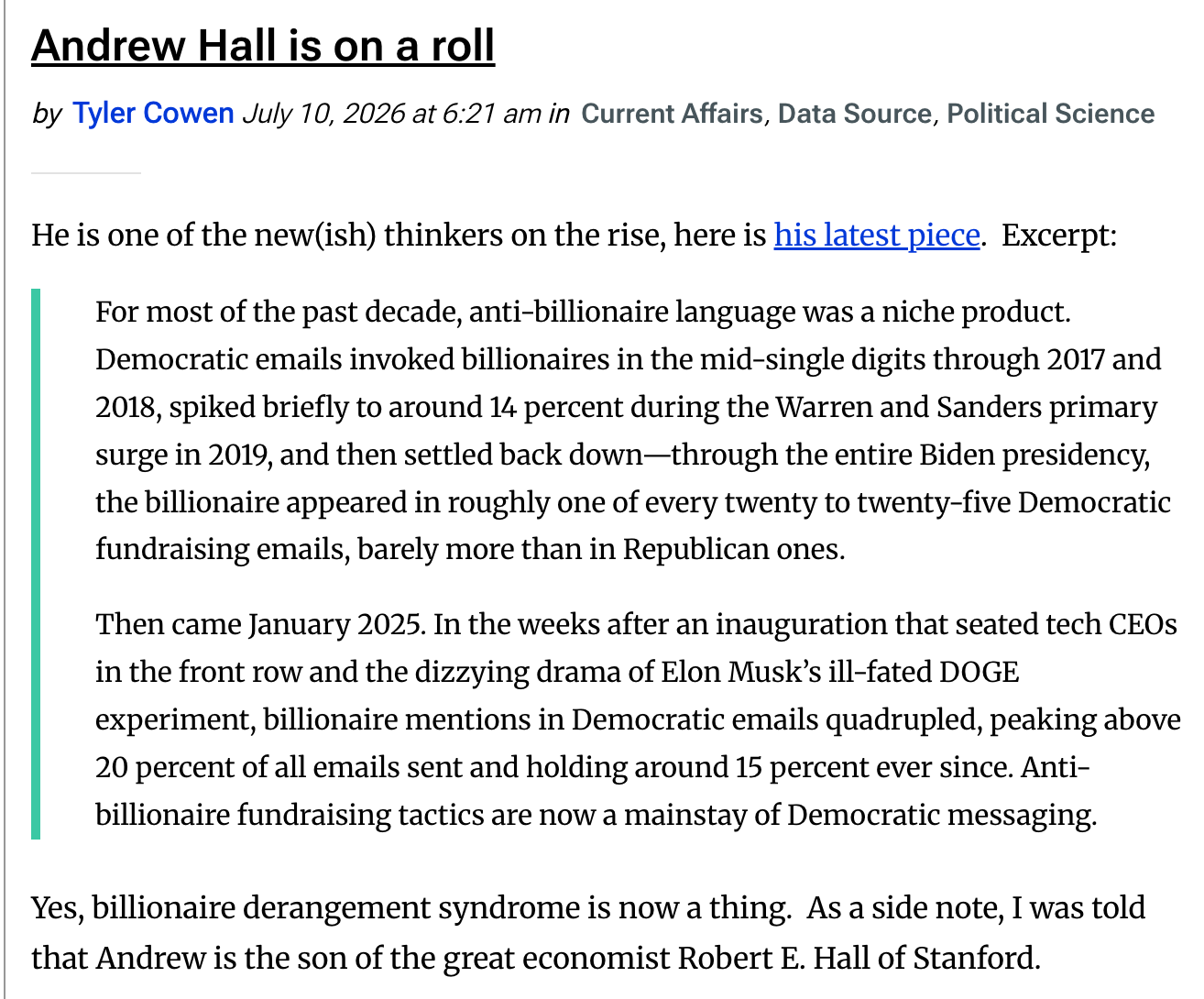
It’s been a big week for Free Systems. First, we released our new research on how fundraising emails show the Democrats’ turn towards anti-billionaire populism and, more recently, towards tying AI to this issue. That research is generating a lot of interest, including this very kind Marginal Revolution post by Tyler Cowen:
Second: we’ve decided to play the Substack game. Chris Dixon’s excellent book (note: I’m an advisor at his fund) Read Write Own explained how online platforms inevitably seek to control their networks. Substack is no exception. The basic idea of Substack was, originally, that you the author own your distribution, because it’s email-based.
But increasingly, Substack encourages distribution through its social feed. When users “follow” you, they get your updates on their Substack feed, but you don’t get their email addresses. This is how Substack will shift from a platform in which the authors own their distribution to one in which Substack owns the distribution. You can’t just rely on emailing your piece to your subscribers; you need Substack to boost it into other users’ feeds.
This then leads to a second implication. Substack makes money by taking a cut on subscription. So they really want authors to charge for subscriptions. If you charge for subscriptions, you can get significant reach—that is, Substack will put your content into people’s feeds and encourage them to subscribe. If you don’t charge, you don’t get this reach.
I have no interest in charging for my content. Indeed, the whole motivation for Free Systems is to get our ideas and research out as broadly as possible.
But I do have interest in getting reach, to further my goal of having impact. So, this past week, I finally caved and added paid subscriptions to Free Systems. And it’s already working! In one week, we’ve already hit 18th in the “Rising in Technology” list on Substack, which is awesome!

Pay for a subscription to boost our reach and fund the community!
Here’s how I’m handling paid subscriptions. I am not gating any of the research – all of my pieces will continue to be completely free to read in full. I’m also not pocketing any of the money from the paid subscriptions. Instead, we’ll put all the subscriptions into a Free Systems community fund. That fund will be used to pay for in-person and online events, grants for students, and other Free Systems programming. For now, you just have my word on this…but I’m also going to work on creating a fun crypto pipeline that takes the subscriptions and puts them into a crypto wallet whose balance and spending subscribers will be able to audit themselves.
So, even if you don’t normally pay for subscriptions, I hope you’ll consider adding one for Free Systems—it will help us climb the leaderboard, get more reach, and fund cool events.
100x research institute – six months in
Within an hour of releasing my new research based on political fundraising emails last week, two people—John Horton and Milan Singh—had already released new analyses based on the data, thanks to the use of coding agents. This is very much in keeping with the vision I laid out in the piece I wrote for Roots of Progress on how we’ll get to the 100x research institute. Part of the dream is having people quickly fork and build on new research! So this was fantastic to see.


Other things haven’t developed as much as I predicted, so far. In January, I claimed that a “freight train” was coming for political science because people would use AI to produce 1,000s of papers, many of them of dubious quality. But weirdly, that doesn’t seem to be happening yet?

It seems to be happening thus far in certain parts of the hard sciences—where paper submissions are up massively—but less so in the social sciences, which is surprising to me.


Tracking the Slopocalypse
In other ways, though, the slopocalypse is well under way. Here’s a great report that Pangram, my favorite AI detector, put out, showing the widespread use of AI-generated text on social media, especially for longer-form content.
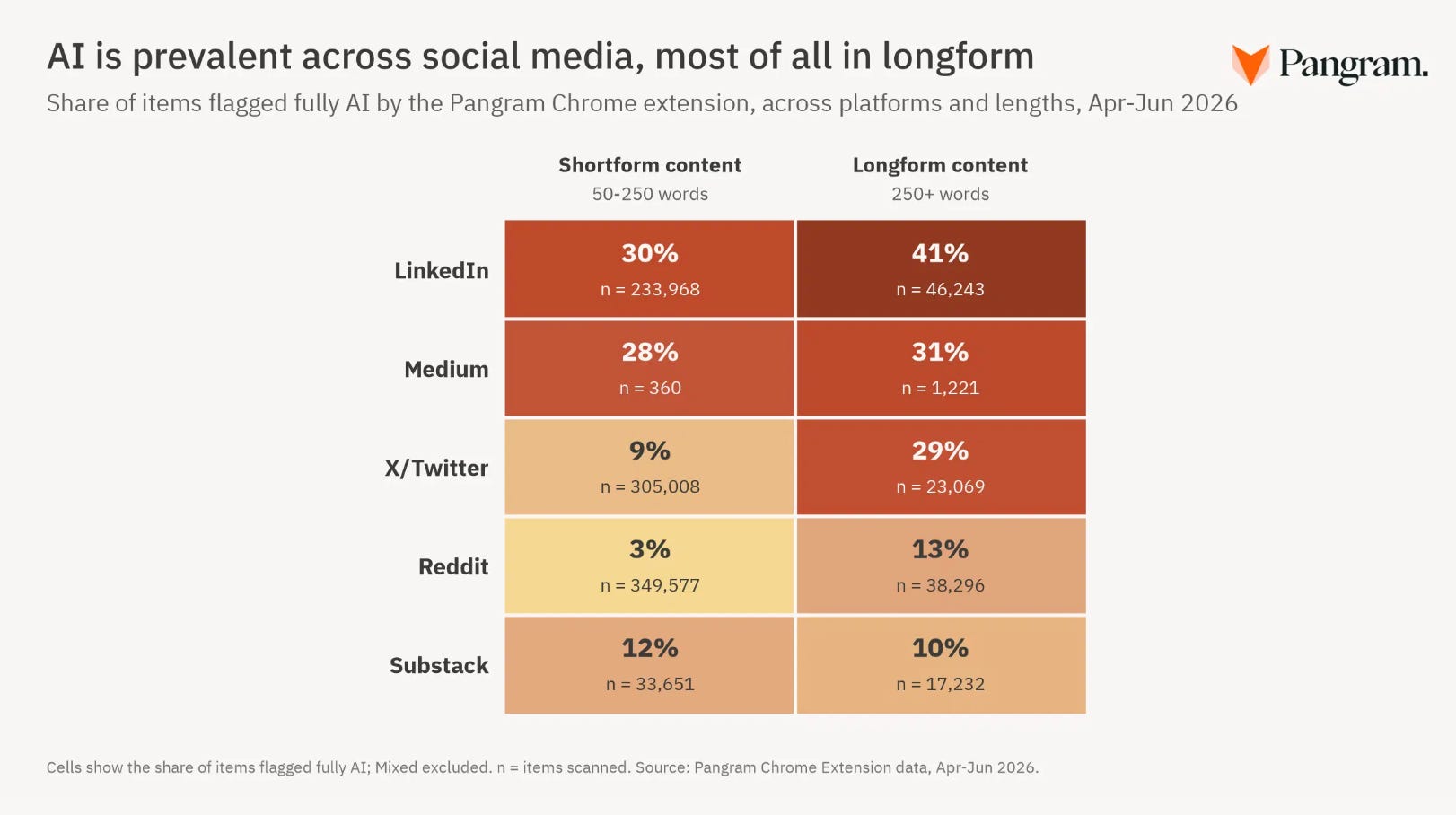
I don’t think there’s anything inherently wrong with generating text with AI. And I worry that sometimes Pangram is used to shame people unnecessarily as part of a “gotcha” game, as Alexander Kustov has argued.
At the same time, there are two reasons the trend is troubling to people right now. First, the quality of the text is often loathsome—indeed, I swear it’s gotten worse rather than better with newer models. I just cannot stand the “Claudeslop” that Fable and Opus now put out for me. Maybe I’m just getting too used to it?
Second, we don’t have time to read all the text put in front of us. So we have to use shortcuts to infer what text is worth reading and what’s not. When we see something that’s obviously AI generated, it signals to some of us, some of the time, that the text was produced without much thought, and isn’t worth our time. I’m not sure that inference will always be true, but it’s a reasonable inference today.
For both of these reasons, I’m relatively cautious in using AI to help me write—but I do use it in some circumstances, and I don’t promise not to!
Tweet of the Week
Continued momentum in the space of building technology to help companies own their own AI, as highlighted by MTS…


Question of the Week
Are you doing interesting new research studying AI, politics, and/or governance? Or new political science/political economy research using AI in innovative ways? Consider emailing it to me! I’ll be making a point to cover new research in System Check, and people have recently started pitching me their new papers which is awesome.