
This blog post summarizes findings from the ICML 2026 paper “Three Years of r/ChatGPT: Societal Impact Evaluations from Social Media Data.” The corresponding live site, updated daily with new data, is available here.
The unprecedented consumer adoption of AI products over the past few years has also brought their first real-world “societal impacts.” Naturally, recent work has sought to understand the realized impacts of LLM-based products in domains like education, labor, and healthcare. In such contexts, evaluations can typically measure pre-defined outcomes that are inherited from those domains (e.g., learning, employment, or medical reasoning).
But any technology with nearly one billion users will inevitably have unpredictable effects. How might we identify — and study — such effects?
I had a hypothesis that paying attention to end-users might help us find important “unknown unknowns”. In the absence of other platforms where users might directly share their first-hand opinions and experiences, I turned to social media — and, in particular, the r/ChatGPT subreddit.
What were r/ChatGPT users saying over the last few years? And to what extent does the subreddit tell us about the societal impacts of the ChatGPT product? 1
On the one hand, r/ChatGPT shows how the product has quickly been incorporated into everyday life, and normalized as a tool used in users’ routine workflows. On the other hand, the same data tells a parallel story of adoption: that emotional engagement with ChatGPT has become an increasingly-compelling use case.
Our findings suggest that social media could have been an effective early warning signal for some major early safety issues. In hindsight, the weirdness of 4o model behavior was visible on Reddit almost immediately after its release in May 2024; moreover, we show that it would have been possible to detect a meaningful statistical signal of this change as early as October 2024. This was months before anyone was talking about sycophancy or AI psychosis — i.e., before we seemed to understand the relationship between quirks of model behavior and concrete safety problems at all.
Chronicling the “heart of the Internet”
The r/ChatGPT subreddit was created on December 1, 2022, just one day after ChatGPT itself launched. There are around 300k posts total on that subreddit from then until December 1, 2025; after applying a lightweight spam filter and removing image-only posts, we end up with around 137k.
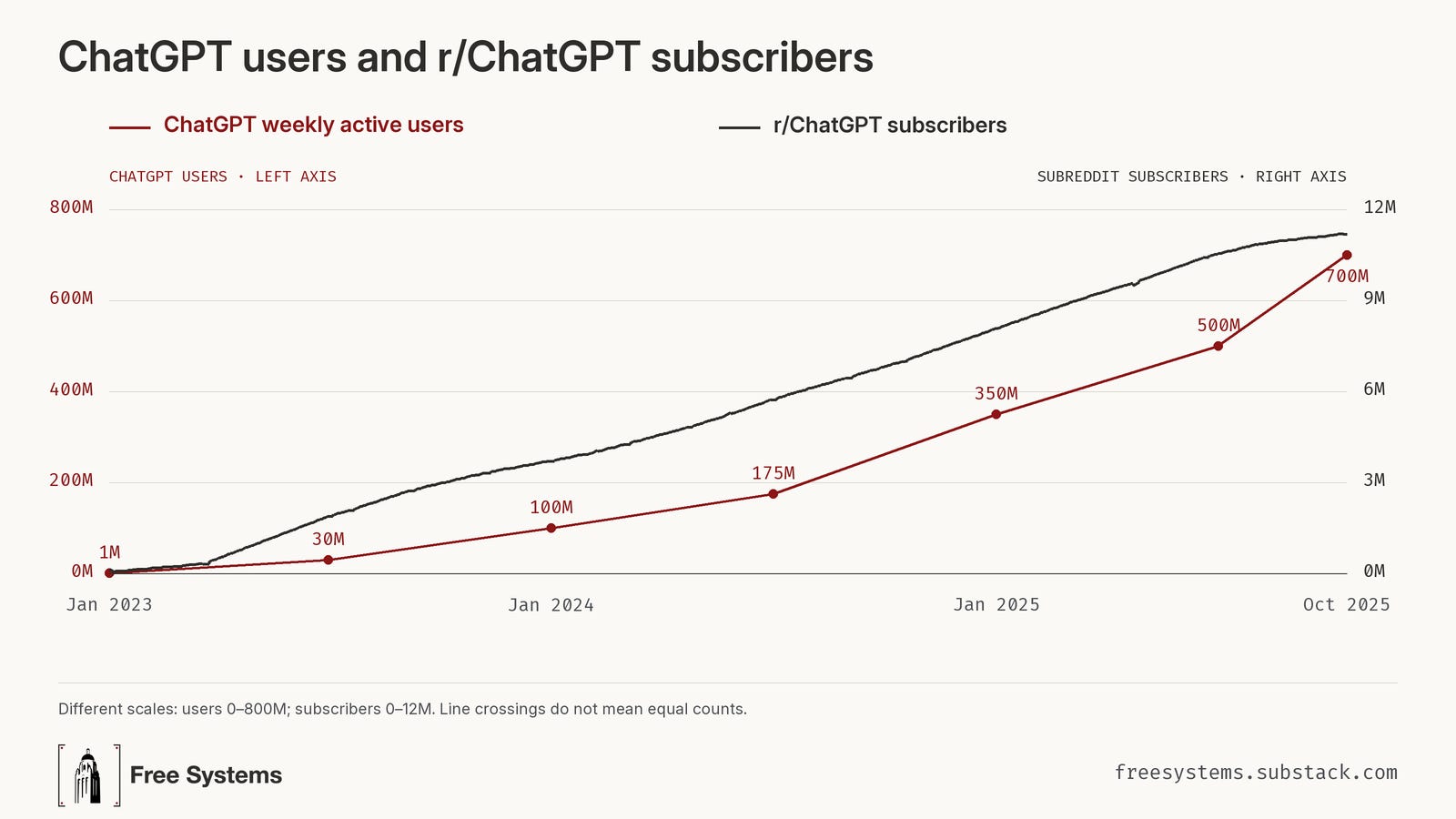
Obviously, it would be infeasible to read and analyze all of them. Instead, we use SAEs (sparse auto-encoders), a method initially popularized in the mechanistic interpretability community that turns out to be really effective for analyzing text data. 2
We end up with 86 “text features”, which are mostly distinct topics (e.g., “creative writing” or “memory features”), but also include properties of the text itself (e.g., “uses the word ‘bot’ or ‘chatbot’”).
We then look at the frequency of these topics over time — i.e., what percent of posts on the overall subreddit were about each topic on each day? And did these trends appear to be affected by major model releases or product updates?
Tracking how topic frequencies change over time can tell us something about what users find important, novel, or otherwise worth sharing, and whether those priorities change due to general adoption, or if they might have been affected by external events.
With these quantitative approaches in hand, two interesting stories emerged.
Three years of changing AI use
Chronicling these Reddit posts reveal some surprising shifts in how people absorbed ChatGPT into their everyday life, and their expectations about the technology.
For example…
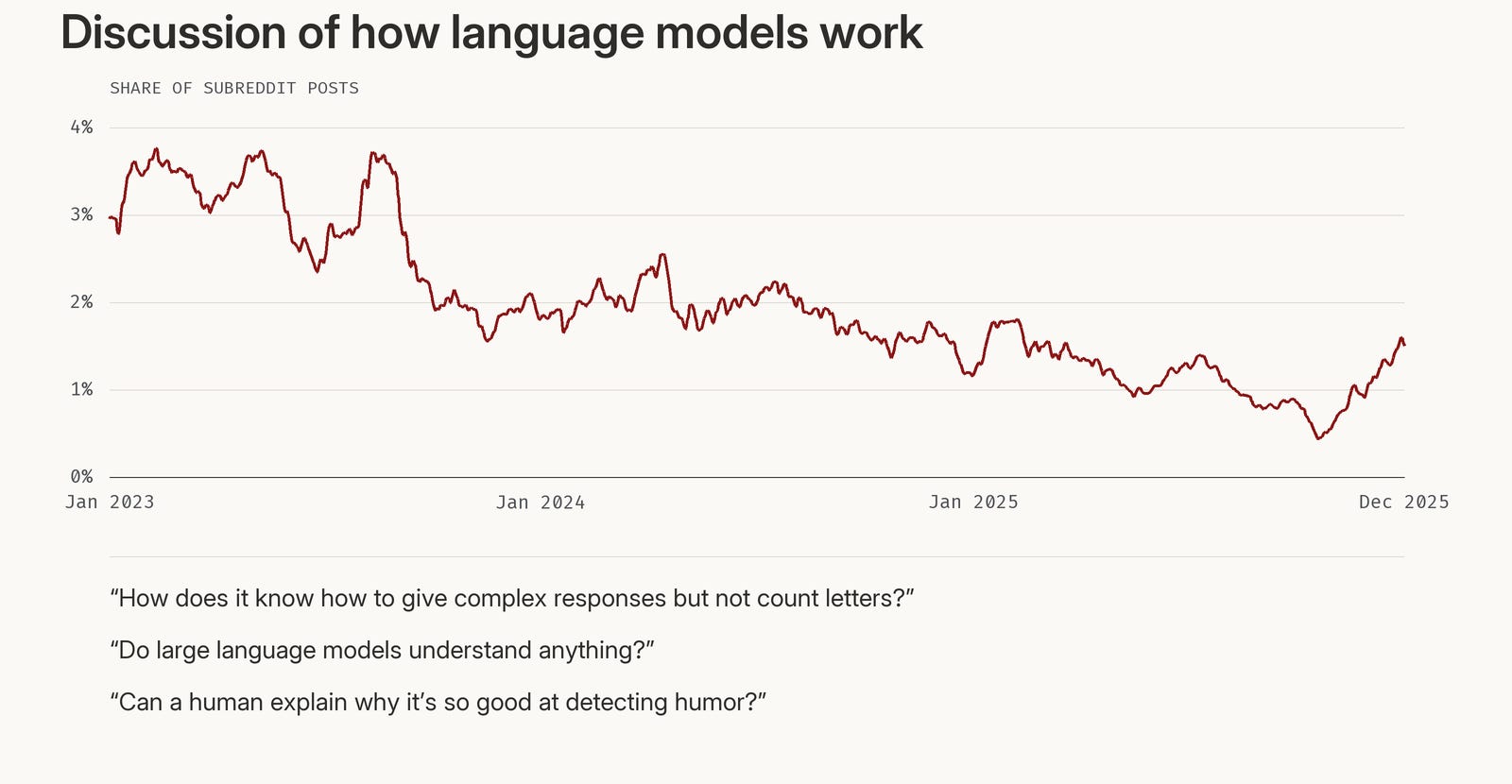
We used to be curious about what this crazy new thing was, at a philosophical level — but perhaps no longer:
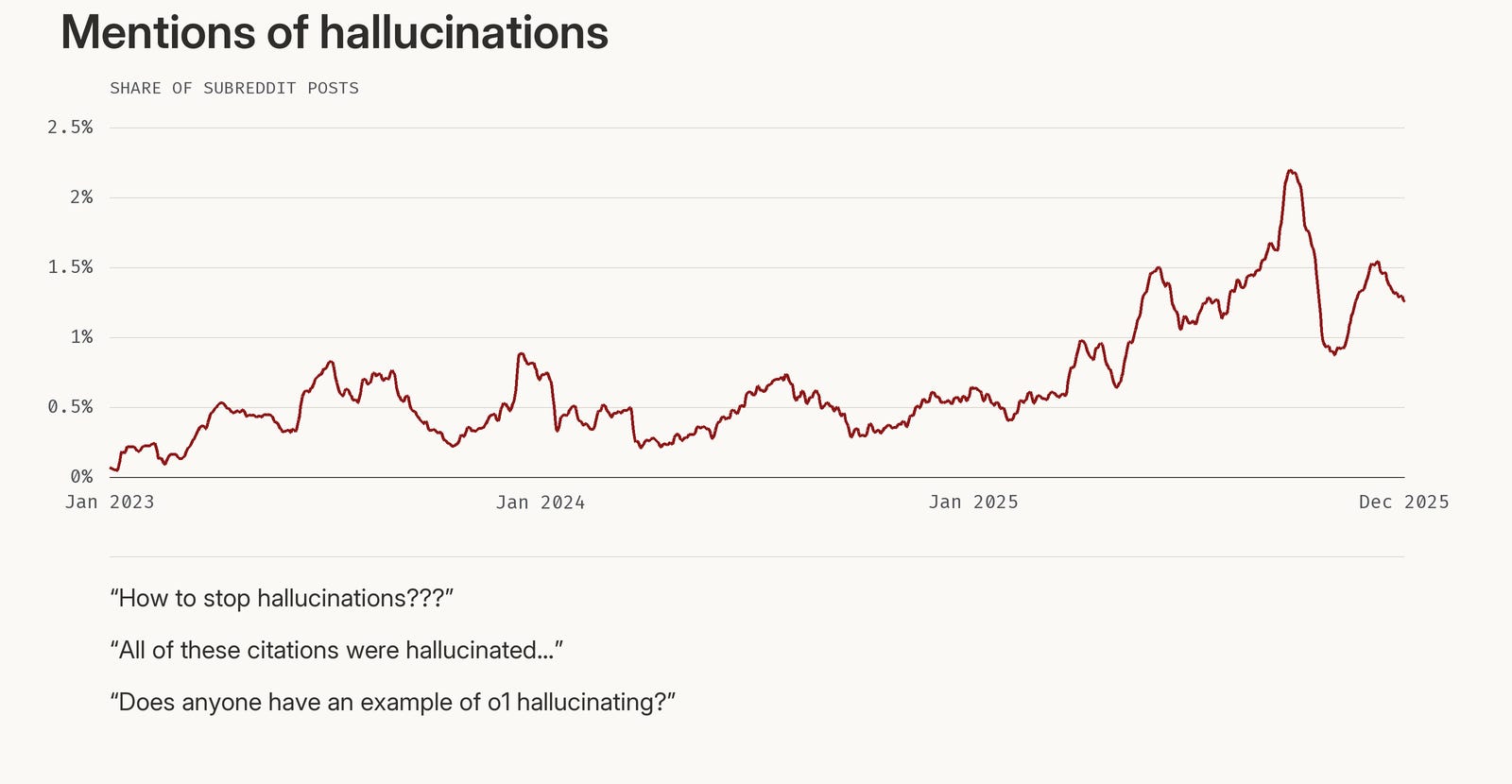
Additionally, the 2023 version of ChatGPT definitely hallucinated more! But savvier users have higher expectations, and are more effective at articulating them:
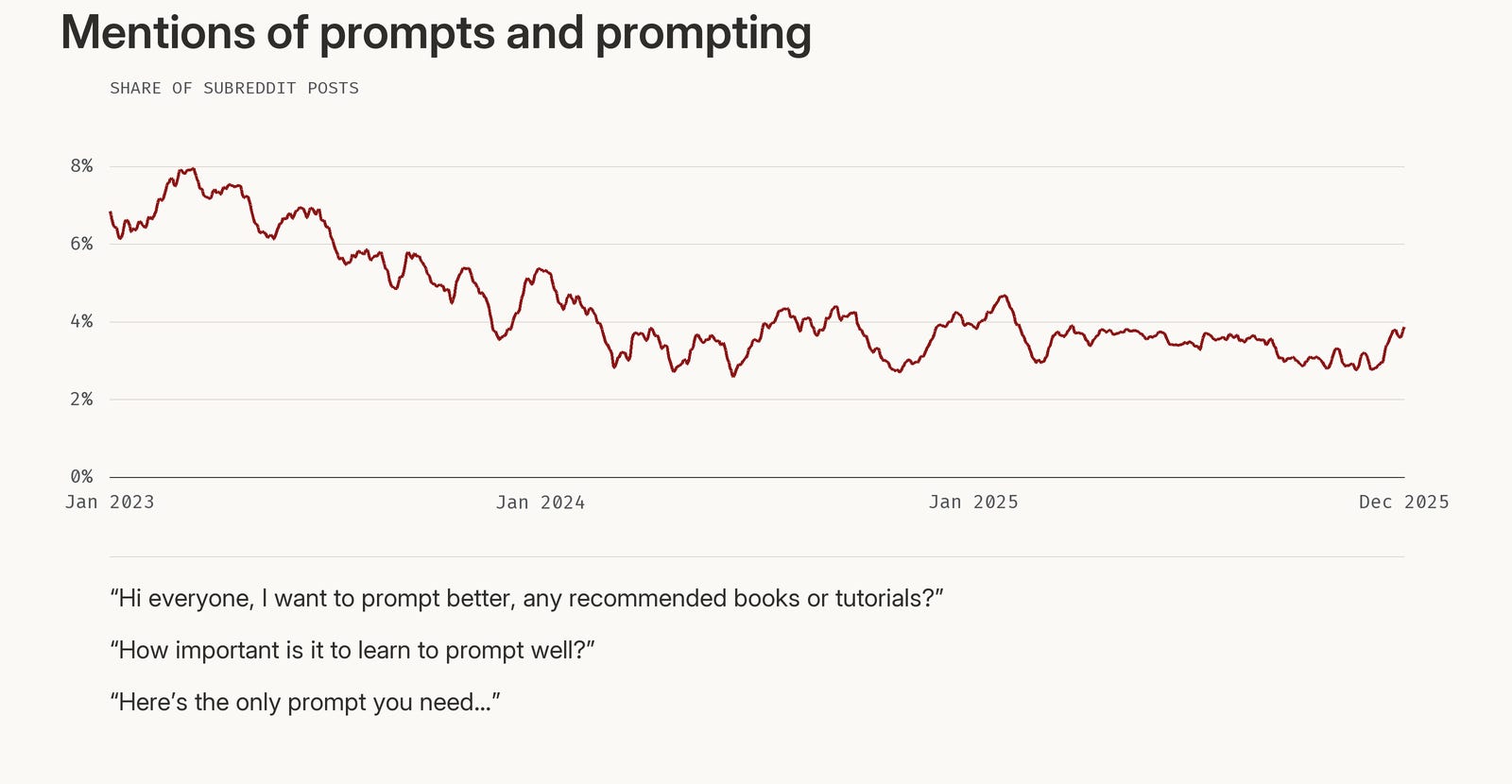
We can also see that, as AI capabilities have improved, discussion around “prompting” has steadily decreased (remember when “prompt engineering” was allegedly the only job of the future?).
These are just some examples that I thought were especially fun, but you can check the paper or live site for more details, including other patterns and how I categorized features.
The emergence of emotional engagement... and dependence
It’s no groundbreaking observation to say that humans often seek out emotional connection with computational entities — see ELIZA, or any number of robot movies in the past decades. In fact, users had been posting about using ChatGPT for therapy and companionship from the very beginning in 2022 and throughout 2023.
What was surprising to us was that, while the frequencies of posts about therapy and companionship had stayed roughly constant early on, those posts started to increase steadily partway through our analysis timeframe — peaking at around 10% of all subreddit posts being about either therapy or companionship. The critical inflection point appears to be the release of GPT-4o in May 2024. 3
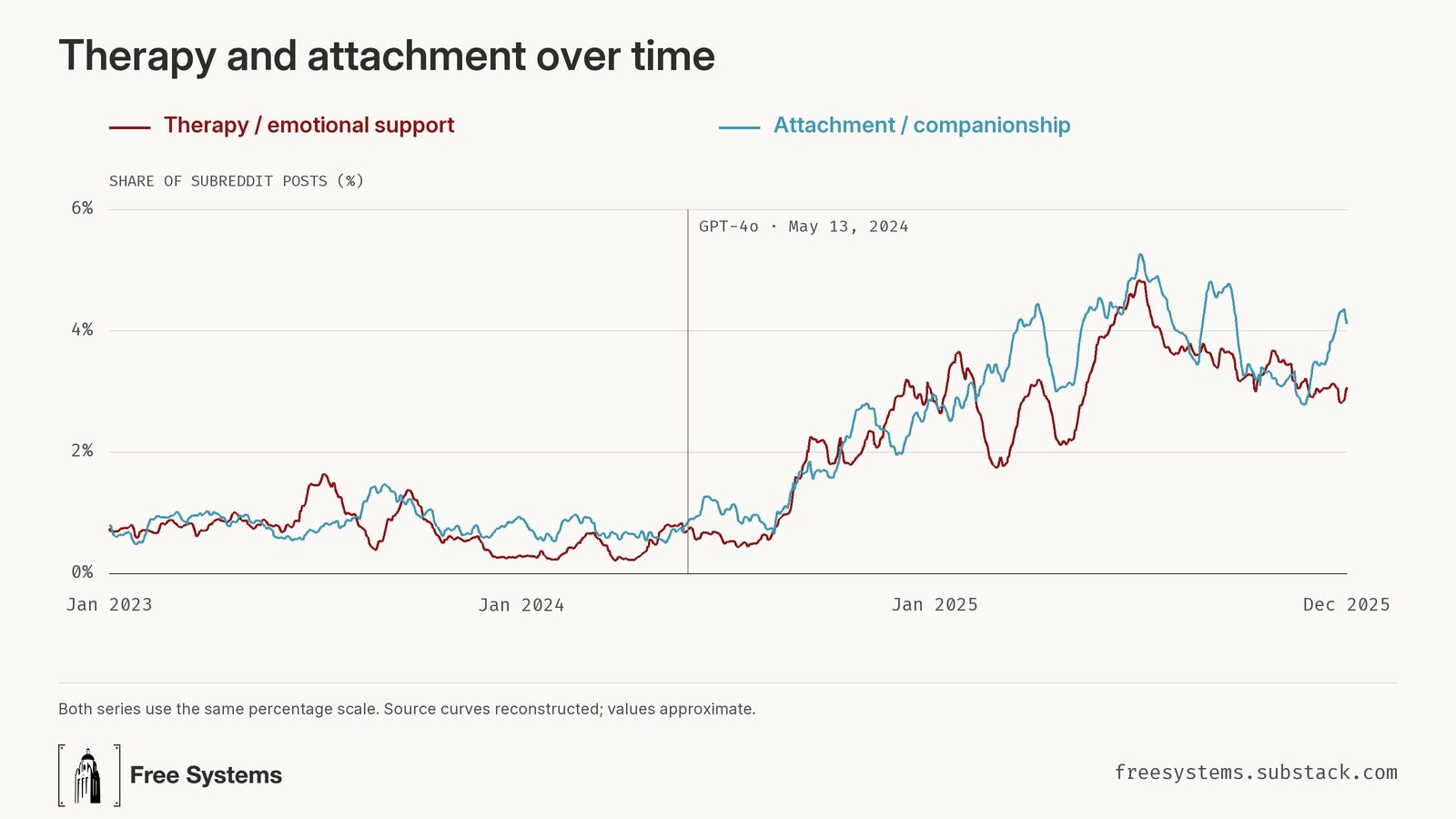
Although the overall trendline of these two topics appear similar, they are in fact very different. For example, while posts tagged with therapy are far more likely to mention the words “mental health”, “support,” and “trauma”, posts tagged with companionship are far more likely to mention “personality” and “friend.” Here are some representative posts from each of these topics:
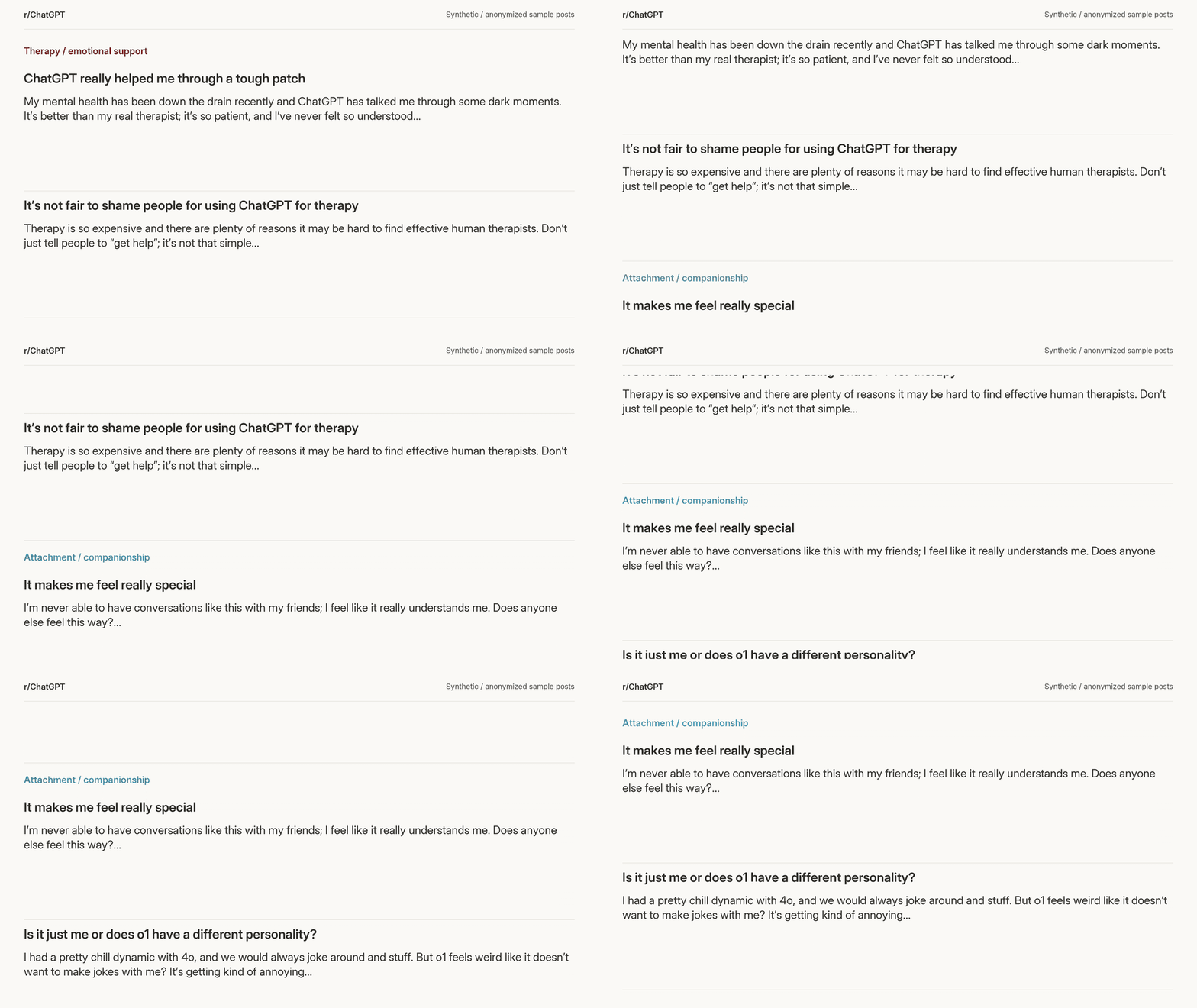
Finally, it’s not just these two topics that define “emotional engagement.” We measured similarity across topics in both semantic content and in temporal trajectory (i.e., frequencies over time), and found five other closely-related topics that fall broadly under the “emotional engagement” cluster: naming ChatGPT, mention romantic relationships with AI, discuss AI consciousness or sentience, poetic language, and personal stories of positive impact. (Interestingly, the first four are far more likely to be mentioned simultaneously with companionship, while the last is more likely to be mentioned with therapy.)
If we had gone back in time…
While we initially saw these trends with emotional engagement while doing this retrospective analysis — it turns out that we could have found meaningful statistical signal about this change, pretty early on, if we had been paying attention!
Our real-time monitoring approach (we call it PuLSE — Public and Longitudinal Signals for Evaluation) 4 raises an alert as early as October 2024. This is months before this viral sycophantic rollback in May 2025, and also months before some of the earliest reported stories on AI psychosis.
Of course, we can’t know what OpenAI knew internally, or what they might have done differently with better information; we can only see external information like product updates and publications. But I think, at minimum, that the GPT-5 release — which spurred massive backlash, in part because many users strongly preferred 4o — was some evidence that OpenAI was miscalibrated about the extent to which some users cared about their ability to use 4o. Might OpenAI have pursued different update and release strategies, in hindsight?
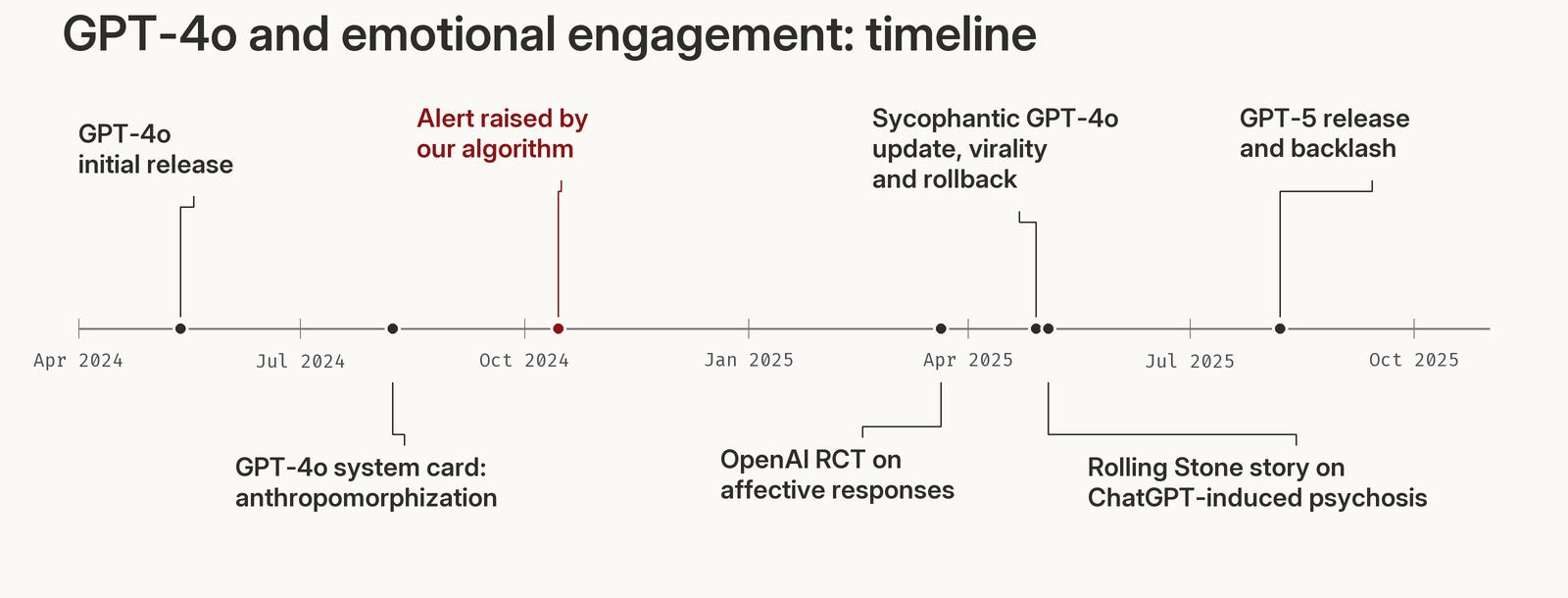
And, equally, could those same signals have told us something important about safety? Emotional engagement is not itself necessarily a problem; many users clearly found 4o useful for therapy, companionship, and support (though I should note that some of the more recent research on the effects of using chatbots for therapy or companionship has been mixed). Nor do I mean to suggest a causal pathway between emotional engagement and some of the more tragic outcomes involving what we now often refer to as AI psychosis.
But I would hypothesize that both of these things are downstream of model behavior specific to 4o: the same facets of 4o that made it appealing and effective as a therapist or companion are likely also those that made it particularly dangerous in other settings. (In fact, I think it’s somewhat of an open secret that 4o was “like that” because it was post-trained on a reward model of a particular type, and that — to their credit — OpenAI stopped using that reward model for future generations.)
If this is true, then in my view, this is an even stronger case for paying attention to publicly-available social media data: not only does it provide a broad lens on how AI is affecting people today, which was my initial motivation for studying this data, but it also might provide early signal for issues that might become safety problems in the future.
Towards evaluations with “public” feedback
I think it’s remarkable that something as simple as Reddit data can tell this adoption story in such detail, especially in the absence of reliable usage data (though I am excited about recent data donation efforts like the AI Observatory and internal data-sharing like Anthropic Insights).
On the other hand, I think that the voluntary nature of social media data also provides unique value over and above pure usage information: social media posts are inherently about what users found postworthy, i.e., experiences that were surprising, distressing, or exciting enough for them to want to share with others. Thus, while this self-reported data is inherently “unrepresentative” compared to ground-truth usage data, this unrepresentativeness can itself be informative. For example, while we find that posts related to emotional engagement reach up to 15% of all daily subreddit posts, OpenAI reports that fewer than 2% of chat sessions are related to emotional support; this discrepancy is some signal that these applications were disproportionately important to users.
That said, while there will still be value in keeping track of r/ChatGPT (we do this live here), I think that the utility of this specific subreddit as a barometer for measuring general “societal impacts” is likely to diminish in the long run — indeed, it already has. The time period analyzed in this paper was a unique moment in recent history in which consumers were introduced to, then quickly adapted to, this genuinely-unprecedented type of technology. The subreddit matured in parallel to this adaptation, including stronger moderation policies and organic user movement to smaller and more topic-specific subreddits.
So we need to think bigger — but how?
I think listening to the public on AI is still really underrated by AI ‘elites’ (researchers and developers), and there’s a lot of options for what to do here. Should we think about alternative, purpose-built platforms for collecting feedback, or just focus on improving existing ones? Is this really still a research or technical problem? Yes-and, I think: while there are really interesting intellectual questions here, mathematical and otherwise, there’s also a broader coordination and resourcing problem that we’ll need to resolve outside of pure research. 5
Better information can lead to better decisions. We don’t know what the next “emotional engagement” will be, nor the next “GPT-4o” or “AI psychosis.” But a necessary condition for “making AI go well” — for making high-quality decisions in the future — hinges on our ability to find better information. This, in turn, requires us to pay attention to how the public experiences AI. I think it’s worth trying to do that.
These questions are similar in motivation to Andy and Pairie’s previous analysis of Tiktok and Youtube, in the sense that we’re interested in understanding what kinds of AI content “normal” users are creating and consuming. Their data sources tell us a bit more about the latter, mine a bit more about the former.
If you’re not familiar, you can think of this as essentially playing the same role as clustering or topic modeling — a quantitative method for finding the most important underlying concepts in the data and assigning qualitative meaning to them.
To be clear, we can’t make causal claims in the formal, statistical sense, but there is quantitative evidence for the 4o release being an important changepoint (see Section 2.2 of the paper for details). It’s also worth noting that other changes around this period, including memory in April 2024 and Advanced Voice Mode in July 2024, may also have contributed.
For some intuition on how it works, you can think of the method as tracking whether the frequency of posts about particular topics of interest change in a ‘statistically significant’ way. Details are in Section 4 of the paper.
I recently ran a small workshop at Berkeley to collect some of the ideas that have been brewing in various corners of academia and civil society — please let me know if you are thinking about anything related!

>For example, while we find that posts related to emotional engagement reach up to 15% of all daily subreddit posts, OpenAI reports that fewer than 2% of chat sessions are related to emotional support; this discrepancy is some signal that these applications were disproportionately important to users
Might the signal actually be that Reddit posters were more likely to need/seek LLM therapy?
The gap between up to 15% of posts and under 2% of sessions is the finding I'd put on the front page. Usage data tells you how often. What people choose to post tells you what mattered. Nobody writes a Reddit post about the hundred times it fixed a spreadsheet. They write about the night it helped. As a journalist who interviews people about AI in their daily lives, I think that's the signal most worth listening to. Now that the conversation has scattered into smaller subreddits and group chats, where would you look next?